Pilot Production Planning for Complex Mechanical Assemblies
Misaligned process schedules across suppliers stall assembly, not manufacturing capability.

Pilot production planning for complex mechanical assemblies must get every required part ready for assembly together. For hardware startups buying fast-turn custom parts, the strongest plan starts with early design for manufacturability, works backward from assembly, and puts one owner in charge of the full bill of materials. A fast machined housing cannot rescue a pilot run that is still waiting for its springs.
Why pilot runs for complex assemblies fail at the coordination layer, not the manufacturing layer
The pilot line sits idle while one spring order or one anodizing batch holds up assembly. Every other part can be ready and correct, yet the build cannot proceed. The missing part may come from a shop that is fully capable of making it. What failed was the coordination between that shop’s schedule and the schedules of every other process feeding the build.
That gap is structural in a fragmented supply chain. Each shop manages its own work, but no single vendor owns the dependencies across machining, sheet metal, specialty fabrication, and finishing. As the bill of materials, or BOM, spans more process categories, it gains more independent sources of delay. The problem often stays hidden until integration, when the parts must come together and there is little time left to catch up.
How misaligned lead-time clocks across process categories create the single-part stall
Each process has a lead-time clock, which includes the waits and work needed to deliver a usable part. CNC and sheet metal are typically among the fastest categories, so they can create a false expectation for the rest of the BOM. Western Spring says a typical custom spring order takes two to four weeks with complete drawings and common materials, which leaves out the time to get specialty materials and send parts out for external finishing. CRD MFG states that standard custom tube bending takes 4 to 12 weeks from RFQ to delivery, with specialty materials and unique tooling extending the schedule.
Finishing adds another clock after fabrication. Anodizing, plating, and coating depend on finishing shops with their own queues and batch schedules. Missing a batch slot can add days to a week or more, even though the part itself is already made. The critical path is therefore the chain of dependent steps that determines when assembly can start.
The integration date is the date all parts must be on hand for assembly. Every process clock has to run backward from that shared anchor. OneWeekParts consolidates multiple process categories under one master schedule, addressing the ownership gap that separate vendor timelines leave open.
Why DFM must happen before design finalization, and what happens when it does not
A schedule built around the wrong design will not survive contact with fabrication. Design for manufacturability, or DFM, must happen before design finalization because a late correction turns planned production into re-engineering. The revision does not merely delay the affected part. It can reset dependent process clocks while other parts continue toward delivery, breaking the synchronization the schedule was meant to create.
The geometry problems differ by process, but the scheduling consequence is the same. Deep, narrow CNC pockets can need long, thin end mills that deflect and leave tapered walls, while internal corners that do not match standard end mill sizes can force a shop to order custom tooling. Tube bending needs geometry lock before fabrication because later changes can mean changes to the tooling and a reset of the whole schedule. Unnecessarily tight spring or gasket tolerances create a related problem by adding slower production, secondary work, or more inspection.
Early review exposes those demands while the design can still change without disrupting production. Instant DFM feedback during quoting, available through options including OneWeekParts, helps move manufacturability review ahead of commitment. But the review also needs to cover drawings, tolerances, materials, and fabrication sequences across the build. Fragmented sourcing makes late DFM the default because each shop sees only its own parts, while consolidation makes a full-BOM review possible before production starts.
How to build a synchronized cross-process schedule for a multi-process BOM
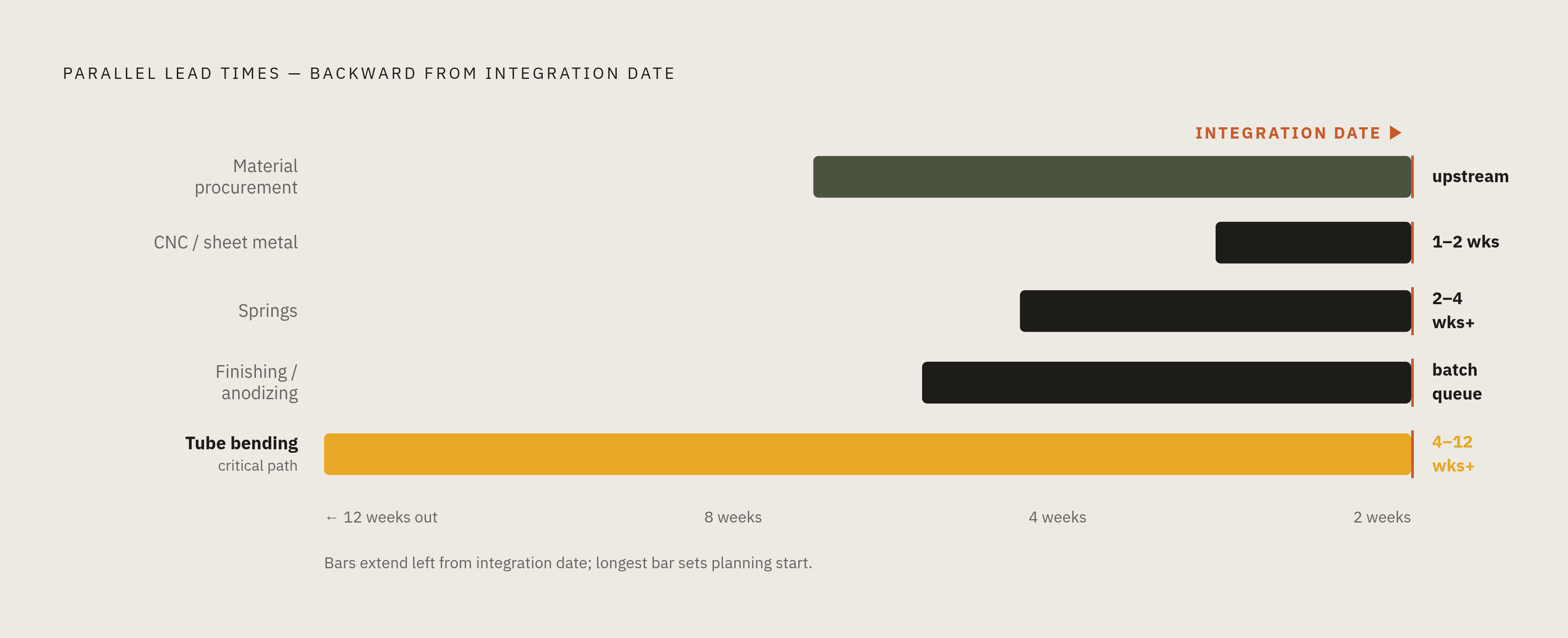
Start with the integration date and treat it as the fixed anchor. Map every BOM line to its process category, then assign a realistic lead time for the whole route to delivery. That route includes material procurement, fabrication, finishing, and inspection. Finishing must have its own step after fabrication, with its own queue, since folding it into the fabrication estimate can make the timing look too short.
Next, identify the longest-lead parts and materials, and establish their order dates first. Raw structural and seamless mechanical tubing has an upstream wait that belongs before the bending operation. Where the material category is known, pre-ordering long-lead material before drawings are finalized can remove that wait from the fabrication critical path. This is a targeted way to shorten the schedule without pretending that fabrication itself can happen faster.
Then work backward from integration to find the start date for each process stream on its own. Check whether a design decision in one stream depends on a part from another, since separate start dates do not remove physical dependencies. Allow time to prepare the quotation and bring the fabricator in early so the shop is ready when the design is. CRD MFG says clear specifications cut the time to quote tube-bending work from days to hours. Finally, give engineering change orders their own step in the schedule and send each change to all affected streams at once, so revised parts do not arrive alongside parts made to an old design.
How should hardware startups choose processes and materials for fast-turn custom parts?
At pilot scale, speed-to-verified-part matters more than getting the cost per unit as low as it can go in the long run. Scheduling discipline can remove avoidable waiting, but it cannot erase tooling or material requirements built into the design. For sheet metal pilots, CNC laser-and-bend workflows avoid the expensive hardened tooling required by stamping. Stamping becomes cost-positive at quantities above those of a typical pilot, so choosing it too early can add both tooling cost and tooling lead time to a small run.
Complex geometry may call for replacing machining a solid block with a hybrid CNC-and-additive approach. Additive manufacturing provides the complex shape, while CNC finishing supplies tight tolerances at critical interfaces. The decision rule is to put precision where the assembly needs it without imposing the same manufacturing route on the entire part. Carbon fiber and composite parts need separate scoping because layup sequence, fiber orientation, cure verification, and non-destructive inspection do not fit the standard metallic-part workflow.
Specialty alloys and gauges can take longer to procure than the parts take to fabricate, so their availability belongs in the backward calculation. Die casting and metal injection molding also need plans that look further ahead because their long lead times and the cost of their tooling make them a poor fit for typical pilot quantities. Identify that boundary early so tooling orders for a later high-volume build do not compete with the pilot schedule.
What a complete CAD-to-quote package contains and why incomplete submissions multiply lead time
The request for quotation, or RFQ, is where the design becomes a set of manufacturing instructions. A package with missing information delays quoting and leaves people to make assumptions during programming, production, and inspection. A part can match the supplied file and still fail in assembly if the file leaves out the requirements that matter. Prepare the technical package as part of production planning.
The package needs a 3D model, with STEP preferred, as the geometry reference. It also needs a 2D drawing that carries tolerances, GD&T, threads, surface roughness, heat treatment, coating, masking, inspection notes, and revision information. Specify the material by alloy and condition rather than material family, and state the target quantity because process and tooling choices depend on it.
More demanding specifications do not automatically make a better package. Over-tolerancing is the most common and most costly submission error because it pushes work into slower production and heavier inspection without necessarily improving the assembly. Tight tolerances belong on features that control fit, function, or an assembly interface. For springs and gaskets, asking for more precision than needed can change how the parts are made or inspected enough to make delivery take much longer. Review and complete the whole BOM before sending it in, because each part file with missing information causes its own delay, and those delays can add up across the build.
How vendor consolidation eliminates the coordination costs that fragmented sourcing makes invisible
Individual invoices do not capture the engineering time spent coordinating shops, the freight between facilities, or the inventory cost of parts arriving out of sequence. They also hide the cost of quality disputes when one shop’s output becomes another shop’s input.
Consolidation puts one partner in charge of the cross-process schedule, freeing the engineering team from having to manage five separate vendor relationships. When process steps happen internally, the associated inter-facility freight and handling disappear. A single purchase order and shipment also reduce the work of tracking different payment terms, NDA requirements, and communication channels. If a machined part reaches finishing out of specification, the partner can resolve responsibility internally.
The benefit also reaches back into design. A full-BOM review can catch a tolerance stack spanning a machined housing and a sheet metal bracket that neither shop would see alone. For builds spanning CNC, sheet metal, springs, tube bending, gaskets, and surface treatment, OneWeekParts is one option for consolidated sourcing with inspection of every part before shipment. The relevant buying criterion is coverage of the actual BOM under one schedule.
Concentration does create interruption risk if that partner cannot perform. One schedule owner removes the coordination gap, but it does not make production immune to delay. The practical rule is to consolidate where specifications and alternatives are stable, while preserving deliberate redundancy where interruption or change would be expensive. That balances the cost of fragmentation against the consequence of depending on one source.
First article inspection and what it must verify before pilot quantities proceed
First article inspection is the go/no-go gate between making a part and committing to pilot quantities. It checks whether the design, tolerances, choice of process, and what the supplier can do yield the part as intended. GD&T verification commonly uses a coordinate measuring machine, or CMM, to check that the part meets the geometric controls set out in the CAD model or engineering drawing. Measurement must show that the part’s controlled dimensions meet the design, regardless of whether it looks right.
A passing first article establishes a useful baseline only when its process matches the pilot production process. Under that condition, its validation can carry forward without revalidation and reduce the verification burden on subsequent quantities. Springs need process capability verification for critical dimensions because a process that is barely within specification can make parts harder to assemble across pilot quantities.
For gaskets, decide between AQL sampling and full individual inspection before production, based on how critical the application is and how much time each approach takes. Carbon fiber and composite parts need non-destructive inspection, including ultrasonic or CT, scoped as a separate step. Inspection of every part before shipment can also remove incoming inspection work from the engineering team and catch defects before assembly.
A remake-or-refund guarantee provides financial recourse for an out-of-spec part, but financial recovery is not the same as recovering a pilot date. The verification gate therefore belongs inside the production plan, with enough scheduled time to perform the required checks before quantities proceed. Inspection is the final dependency in getting usable parts to integration. Its time belongs in the same backward schedule as material procurement, fabrication, and finishing.