Low-Volume Sheet Metal Fabrication Without Production Tooling
Laser cutting and press brakes replace expensive stamping dies for small production runs.
Low-volume sheet metal fabrication without production tooling uses laser cutting, press brake forming, and related processes in place of custom stamping dies. The payoff is fast-turn custom parts for hardware startups without a large tooling commitment before the design or demand is stable. The right choice depends on geometry, tolerance, and batch size, and a multi-process assembly also needs a plan for sourcing so each separate operation does not add its own delay.
Why low-volume sheet metal exists as a distinct engineering problem
A team buying 50, 200, or a few thousand parts per year has different costs to work through than one buying a million. Stamping dies cost thousands to hundreds of thousands of dollars per set, so each part must carry a share of that investment. Below several thousand parts per year, that share can make stamping uneconomical. At a lower volume, a part of the same complexity has fewer units over which to spread the die cost.
Tooling-free fabrication shifts that expense from a fixed investment to machine time. That works well for teams whose quantities and drawings may change before production settles. It also creates a sourcing problem, since cutting, forming, and assembly must still fit together. Fast-turn multi-process suppliers such as OneWeekParts serve this middle range by putting those operations into one quoting workflow, so the team has fewer separate vendors to coordinate.
How laser cutting, CNC punching, and wire EDM substitute for stamping dies on flat geometry
Process selection starts with the flat geometry and its required tolerance. Laser cutting works well for samples, short runs, and revisions because it is quick to change the programming and setup. Typical cutting accuracy on thin gauge is ±0.1 mm, which is different from the listed positioning accuracy of ±0.05 mm. Machine time drives processing cost, while nesting controls how much sheet the job consumes. Material utilization can still be lower than coil-fed stamping, and some feature types exceed what the laser can hold.
If the part is a perforated panel, ventilation grille, or enclosure with standard feature patterns, CNC punching may fit better. Its programs are easy to adjust, and its tolerances can approach production stamping. Complex contours change that calculation because nibbling takes longer and leaves a rougher edge. Hybrid punch-laser machines can do both, but scrap left between parts still affects how much of the material gets used.
When intricate geometry or tight tolerances rule out those routes, wire EDM may be a fit. It has high precision and an excellent surface finish, and stacking the material lets it make more than one part per setup. Its higher cost needs a reason in the drawing. OneWeekParts gives teams DFM feedback during quoting so they can work out which process fits before choosing how the parts will be made. Across multiple cutting methods, that feedback can replace separate quote cycles with one engineering discussion.
How press brake bending completes the no-tooling workflow after cutting
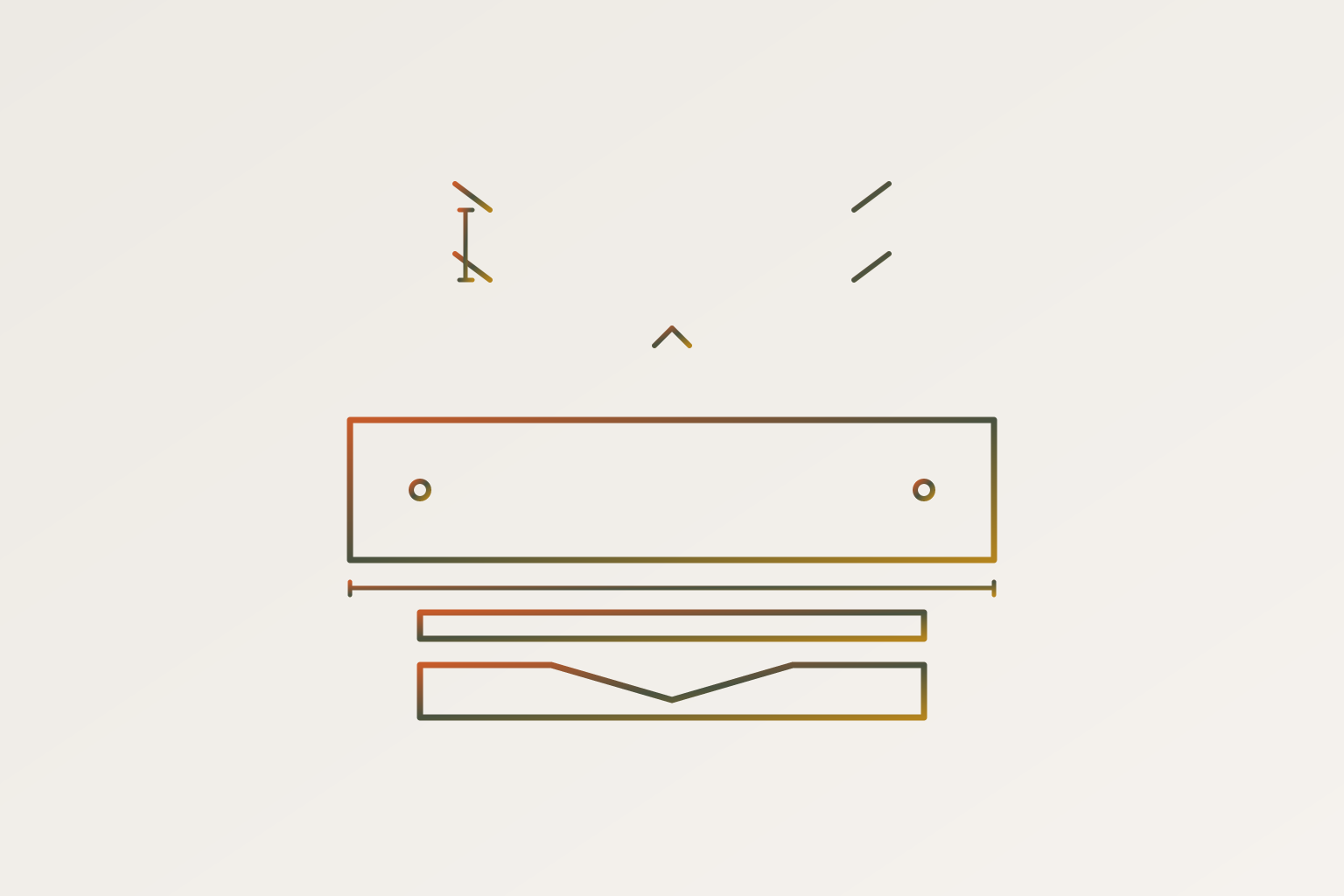
Cutting makes the blank, but bending gives it its three-dimensional form. A CNC press brake positions the sheet between a punch and die and applies force to reach a programmed angle. Standard punch and die sets cover most low-volume geometries, so a custom stamping die is usually unnecessary. Standard bend angle accuracy is ±1°, with ±0.5° available as a higher-cost precision tolerance. “No tooling” therefore means using standard tools without dedicated production tooling.
Standard bend tooling costs $200 to $2,000 per set and can be amortized across thousands of parts. That tooling expense is distinct from the fixed setup cost each batch must absorb. Multiple bend angles and a difficult bend sequence can require more setups, raising the forming cost before the batch is complete. With cutting and bending covered by the same supplier, as in OneWeekParts’ sheet metal scope, geometry changes can be evaluated in one quoting workflow. The important number is the cost of the finished part.
Where quantity break points change which method and which cost logic applies
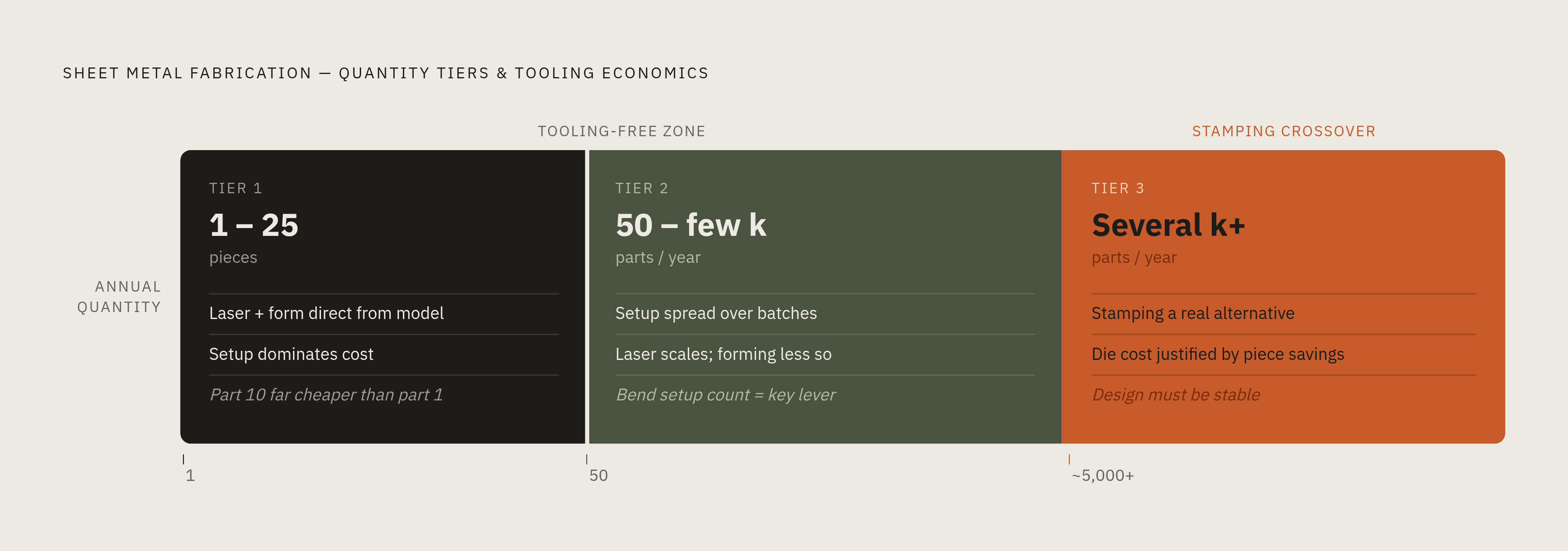
At 1–25 pieces, the job is in prototype and first-article territory. Laser cutting and forming directly from the model avoid a production die, but setup accounts for much of the bill. The tenth part is therefore much cheaper than the first. This tier serves design validation and field trials.
At 50, 200, or a few thousand parts per year, the question shifts toward spreading setup over useful batches. Laser cutting cost scales more smoothly than forming cost, so bend setup can determine how much a larger order saves. A part with several forming setups has more fixed cost to distribute than a simple flat part. The break point depends on that work as well as the annual quantity printed on the RFQ.
Above several thousand parts per year, stamping becomes a serious comparison. The saving in production must justify the die investment, and the design must be stable enough to support that commitment. Cost per piece can step down when a different method becomes worth setting up. These tiers provide a decision framework whose price thresholds depend on the drawing.
Design rules that determine whether a part is cheap or expensive to fabricate without tooling
Start with the inside bend radius, because its minimum depends on the material. Use the same bend radius throughout the part where the design allows it, so the press brake tools can stay in place. That reduces setup time without requiring a larger order.
Next, check holes and features near bends with the finished geometry in mind as well as the flat pattern. The minimum hole diameter should be at least the material thickness so laser cutting is reliable and edge quality stays consistent. Plan the bend sequence from internal features outward so reference edges stay in place while interference-sensitive geometry is formed. Laser-cut features on the blank hold tighter tolerances than formed flanges, making the flat blank the preferred datum plane. Dimension from a single datum surface rather than chaining dimensions from feature to feature, which compounds tolerance stack-up.
Then count setups across the whole route, including bends, welds, and secondary operations. MJM Manufacturing identifies setup count as a significant cost driver at low and medium volume because fewer parts share the expense. Reducing bend count or consolidating separate formed pieces into one bent part cuts that count directly.
Finally, match tolerances and allowances to the actual fit. Standard sheet metal linear tolerance is ±0.1–0.5 mm under ISO 2768-m and depends on nominal dimension size, while precision beyond what the part needs adds inspection cost and scrap. Powder coat adds roughly 2–4 mils of thickness, so leave clearance for it in tabs, slots, and mating features before finishing. Small outline changes can also improve nesting and reduce material cost. Freeze the print before release, since a mid-run revision can scrap material and reset setups.
Material selection for low-volume sheet metal and when to cross into a different process
Material choice sets both the service limits and the forming constraints. Cold-rolled steel (SPCC/DC01) is a general-purpose option for brackets and panels, but it needs coating for corrosion resistance. Galvanized steel puts corrosion protection into the material and suits outdoor enclosures and HVAC. The distinction is whether protection is already present or must be added after fabrication.
Aluminum 5052 offers good formability and weldability for enclosures, marine use, and general forming, with a minimum bend radius of 1× thickness. Aluminum 6061-T6 has higher strength but lower formability, needs larger bend radii, and loses strength in the heat-affected zone when welded. It fits structural brackets and heat sinks where forming demands are modest. Stainless steel 304 provides corrosion resistance for food, medical, and general applications, with a minimum bend radius of 1.5× thickness. Copper and brass offer softness and conductivity for electrical, decorative, and heat transfer parts, at higher material cost.
If the geometry needs a forming die but there are too few parts to pay for hard tooling, polymer additive manufacturing tools are another way to make them. SS304 showed little wrinkling and resisted tearing better than AA6061, and blank holder force helped cut those risks during drawing. The tools degrade over repeated cycles, so this is a bridge for prototypes and low-volume runs. Metal additive manufacturing is also an option at the edge of conventional sheet metal capability, as a different process.
Low-volume stamping tooling strategies when a die is actually the right answer
Avoiding unnecessary tooling does not mean refusing a die when the part needs one. The geometry, surface finish, or tolerance a part needs can rule out laser cutting and press brake forming even at low volume. Wisconsin Metal Parts lists prototype tooling, soft tooling, and single-hit or hand transfer tooling as ways to spend less at the start.
Prototype tooling combines laser cutting, EDM, and temporary tooling to make parts for testing and validation. Soft tooling bridges development and production and may use shared or modular die sets for low-to-medium runs. Single-hit or hand transfer tooling simplifies progressive stamping into individual stations with manual transfer between operations. The decision turns on whether the part must be die-struck, its material and form, its finish and tolerance requirements, and the alternatives available. Low-volume stamped parts can still be fully functional, production-grade parts, especially with hybrid or soft tooling.
Why multi-process BOMs are harder to source than single-process parts, and what that costs in practice
A bill of materials, or BOM, becomes a different sourcing problem once it includes more than fabricated sheet. Machined parts, custom springs, gaskets, formed tubes, and finishes add process requirements beyond cutting and bending. If each goes to a separate supplier, the program also gains more schedules and handoffs. Some work must wait for an earlier operation.
A route involving fabrication, powder coating, hardware insertion, and wiring illustrates the dependency. Each outside operation must fit an external schedule, while each transfer creates another point where specifications can be misread or finishes may not match. Responsibility for a fit or finish problem can also sit between vendors. That is a structural cost of fragmented sourcing.
Specialty processes such as tube bending can have long independent lead times, and rush capacity is not guaranteed. Even when the sheet metal work is quick, the complete assembly has to wait if another part it needs arrives later. Programs with a high part mix, several finishes, and light electromechanical assembly face the most handoffs. For those programs, quote comparison needs to account for coordination, freight, and quality risk as well as part price.
How consolidating a full mechanical BOM with one capable partner resolves the fragmentation problem
Consolidation moves that coordination into a supplier capable of delivering the assembly. Building complete sub-assemblies under one roof reduces transfers, improves consistency and fit, and lowers freight and quality-related risk. The team still needs to check which processes the supplier can handle, even with one quote for all the work. A single purchasing route helps only when the manufacturing scope matches the BOM.
Begin by documenting active fabrication, finishing, and assembly suppliers, together with spend, volume, lead time, quality history, and certification status. Separate commodity parts suited to competitive bidding from engineered and semi-custom parts that need qualification first. Order long-lead items early, agree on terms for sole-source items, and make the make-buy decisions before the RFQ. Then run a pilot on one program or product family and use its results to guide a broader transition.
For teams needing this range, OneWeekParts is one option covering sheet metal, CNC, 3D printing, tube bending, custom springs, gaskets, powder coat, and assembly. Its workflow accepts assembly files or individual part files and brings the work into one quote, one purchase order, and one shipment, with same-day engineer support and DFM feedback during quoting. Every part is inspected before shipment, with a remake or refund if it is out of spec. The deadline still depends on what work the quote covers. For a low- or medium-volume multi-process assembly, the sourcing decision matters as much as the design decision.