Aluminum Alloy Selection for CNC Machined Structural Parts
Copper content and stress-relieved temper make 2024 the fatigue-resistant choice for cyclic loading.
Aluminum makes up somewhere between 60% and 80% of the structural material on most aircraft, and the same logic behind that number drives material choice in automotive brackets, robotics frames, and defense hardware too. Strength-to-weight, machinability, corrosion behavior: these three things decide the alloy, whether the part flies or just sits in a control panel. The trap most engineers fall into is picking by habit (grab 6061, always) or picking by max spec (grab 7075, just in case). Neither is a real decision. A real decision starts with what the part actually has to survive: static load, cyclic fatigue, a caustic environment, or a machining process that will remove most of the stock before the part is done.
For a structural CNC machined part where cyclic fatigue is the governing failure mode, 2024-T351 is the correct alloy and temper combination. Its copper content, running 3 to 5%, is what gives it fatigue resistance that neither 6061 nor 7075 can match, and T351 is the stress-relieved temper recommended specifically for high-performance load-bearing parts. Tensile strength runs close to 500 MPa after solution heat treatment and artificial aging, but raw tensile strength is not the point: 2024 is specified when the part fails from cycling stress rather than a single overload event, which covers vibration, repeated flexing, and dynamic loading conditions. The tradeoffs to plan around are fair corrosion resistance (surface coatings or cladding are typically required), poor decorative anodizing results due to copper content, and a continuous service temperature ceiling of roughly 125°C.
"Structural" here means something specific too. This isn't about cosmetic covers or brackets that just hold wires out of the way. It means parts that carry load, flex under repeated stress, or need to hold a tolerance while getting cut, drilled, and clamped. Before a single tool touches the stock, the alloy has already set four things: how much strength is available, how long the part survives under cyclic loading, how it holds up against corrosion, and how hard it's going to be to machine. Temper and finish then multiply or shrink those four numbers. This piece covers the alloys that actually show up on a structural CNC quote: 6061, 7075, 2024, 5052, and MIC6 for the tooling and fixture cases where dimensional stability matters more than strength.
What 6061 actually delivers and where its limits become relevant
6061 hardens through a magnesium-silicon precipitation process, and it naturally builds a thin oxide layer on its surface that gives it real corrosion resistance without needing a coating. That's a big part of why it shows up everywhere.
In T6 temper, 6061 pulls tensile strength of 310 MPa, yield strength of 276 MPa, fatigue strength around 97 MPa, and Brinell hardness of 95. Those numbers are solid for aircraft fittings, building brackets, and general structural work, but they're not the ceiling for high-stress aerospace parts. If a design needs to push past that strength band, 6061 isn't the answer.
Machinability is where 6061 wins outright. Among the three main structural alloys (6061, 2024, 7075), it machines very well and supports high cutting speeds. Chips form cleanly, dimensional stability holds up well through the cut, and shops can run high cutting speeds without much drama. That's exactly why 6061 dominates prototype runs and short production jobs: less tool wear, fewer surprises, faster turnaround.
Finish-wise, 6061 anodizes beautifully. Smooth, even color, consistent from part to part. If a job needs structural strength and a clean anodized look at the same time, 6061 is usually the first alloy to reach for. It also welds well, one of only two alloys on this list (5052 is the other) where welding is a genuinely practical joining method, which matters for assemblies that mix machined and welded features.
6061 stops being the right call once load demands push toward the top of its strength range, once fatigue cycling becomes the failure mode to design around, or once weight budget gets so tight that every extra MPa of yield strength actually matters. Worth noting: in the UK and across Europe, 6082-T6 fills the same role and follows the same design logic. Typical jobs for 6061: housings, fixtures, brackets, prototypes, and structural parts under moderate load.
What 7075 adds and what it costs the design
7075 runs on a different chemistry entirely. Zinc sits at 5.1 to 6.1%, magnesium at 2.1 to 2.9%, and that zinc-magnesium-copper combination is what pushes the strength-to-weight ratio so far past 6061.
In T6 temper, ultimate tensile strength clears 572 MPa, matching or beating a lot of structural steel grades at roughly a third of the density. That's the entire pitch for 7075: aerospace fittings, high-load brackets, military hardware, gears, shafts, anywhere the weight penalty of steel is a dealbreaker but 6061 doesn't have the strength headroom.
None of that comes free. 7075 cuts fine overall, but its added strength wears down tooling faster, so shops need carefully managed tooling and dialed-in feed rates to keep up. The machining bill runs higher than 6061 before material cost even enters the picture. Thin-walled or high-precision 7075 parts also deform more easily during machining and are more prone to stress release and surface defects, which means more rework and higher scrap risk. The real cost gap between 6061 and 7075 is wider than the raw material price tag suggests.
Corrosion resistance takes a hit too. The zinc and copper content that gives 7075 its strength also makes it less naturally corrosion-resistant than 6061, so coatings or anodizing usually need to be built into the finish plan from the start. Welding is not recommended: it degrades the mechanical properties and raises cracking risk, so 7075 parts are generally designed around bolts and mechanical fasteners instead.
Temper matters a lot here too. T6 gets maximum strength but weakens resistance to stress corrosion. T73 and T76 trade some strength away in exchange for better performance in humid or aggressive environments, worth specifying if the part is going to live somewhere damp or salty.
Which aluminum alloy should you use when cyclic fatigue governs the design?
2024 runs 3 to 5% copper and up to 1.5% magnesium, and that copper content is the reason this alloy handles fatigue so well, and also the reason it corrodes more easily than the others.
Tensile strength runs close to 500 MPa after solution heat treatment and artificial aging, lower than 7075-T6. But raw tensile strength isn't the point with 2024. Fatigue resistance is what sets it apart, and that's the number that matters for parts under vibration or repeated flexing: aircraft wing structures, fuselage components, anything where the part fails from cycling stress rather than a single overload event.
There's a temperature ceiling to watch too. 2024-T351 starts losing meaningful strength above roughly 125°C of continuous service, a hard limit for any part sitting near a heat source.
Machining 2024 means dealing with long, stringy chips. It's manageable, but chip evacuation needs attention, and the overall machinability rating sits above 6061, roughly on par with 7075. Corrosion resistance is only fair, so surface coatings, cladding, or controlled service environments usually come with the territory. The absence of copper in 5052 is exactly why that alloy holds up so much better than 2024 in caustic settings.
Fusion welding and soldering are out for 2024. Gas and arc welding aren't recommended, though resistance/spot welding and friction welding do work, so parts need to be designed around mechanical fastening. Temper options include T3, T4, and T8 for forging and hot working. On cost, aerospace-grade certified 2024 stock adds lead time and expense beyond standard material pricing.
Where 5052 belongs and what it does that the high-strength alloys cannot
5052 belongs to the 5xxx series, magnesium-dominant with no meaningful copper content. That missing copper is precisely what gives 5052 corrosion resistance that neither 2024 nor 7075 can touch in caustic or marine settings.
5052 holds up against concentrated nitric acid, ammonia, and ammonium hydroxide, which makes it a strong pick for enclosures, marine hardware, and anything exposed to harsh chemicals regularly.
Strength is where 5052 gives ground. Brinell hardness is notably lower than the 95 recorded for 6061, so it's not a candidate when structural load-bearing is the top priority. It also can't be heat-treated the way 6061 or 7075 can; its strength cannot be raised through heat treatment the way higher-series alloys can, which caps how far it can go. On the upside, 5052 forms well, so it shows up often in CNC-processed sheet and plate work, not just solid machined stock.
Machining 5052 means watching for built-up edge and long chip formation, so cutting parameters and tool coatings need attention to keep surface quality consistent. Typical applications: marine hardware, enclosures, control panels, electronic brackets, pressure vessels, hydraulic tubing. It anodizes decently too, producing a good matte finish for both decorative work and black anodizing, acceptable cosmetically even if it doesn't quite match 6061 for a smooth, uniform look.
MIC6 and the dimensional stability case for precision bases and tooling
MIC6 is a cast aluminum plate from the 7xxx family, sold fully stress-relieved. That cast, granular structure gives it dimensional stability and flatness that rolled plate simply can't match without extra stress-relief work.
This is why MIC6 shows up in jig plates, machine beds, optical fixtures, tooling bases, and inspection fixtures. These are all parts that need to stay flat and stable while a lot of material gets removed, not parts that carry dynamic structural load.
Its stress-relieved cast structure supports consistent material removal and dimensional stability through the machining process. Its stable cast structure suits applications where flatness must be maintained through heavy stock removal. On cost, 5080 cast plate is worth mentioning as a lower-cost alternative, offering a fine-grain, porosity-free structure with dimensional stability comparable to or exceeding MIC6 at a lower price point, useful when the tooling budget is tight.
If an engineer is speccing MIC6 or 5080 for a load-bearing structural part, that's usually a sign something's off. These grades belong in the tooling and fixture conversation, not the structural hardware one.
Why temper is the other half of the alloy specification
Alloy chemistry sets the ceiling for what a part can do. Temper decides how much of that ceiling actually gets used, and what kind of internal stress the material carries going into the machining process.
T6 means solution heat-treated and artificially aged, and it maximizes strength. It's ideal for tight tolerances and high-speed CNC milling, and it's the most commonly specified temper for structural machined parts across the board.
T651 is the same base alloy and temper as T6, but with a controlled stretching step added after heat treatment that relieves internal stress in the plate. That step matters a lot for larger plates or parts where a significant amount of material gets removed during machining, since it helps prevent warping and distortion mid-job. The practical rule: for high-precision large plates or deep-pocket parts in 6061 or 7075, specify T651. Smaller T6 bar stock is usually stable enough without it.
A few other temper options round out the selection set. Annealed, or O-temper, improves machinability but gives up dimensional stability in exchange. T4 involves solution heat treatment followed by natural aging at room temperature. T351 is the stress-relieved version for 2024, and it's the recommended choice for high-performance load-bearing parts. For load-bearing components specifically, 7075-T6 and 2024-T351 are the two combinations worth defaulting to.
Skip the temper conversation, and residual stress in rolled or extruded stock can cause warping mid-operation, especially in thin-wall features. Scrap rates climb, and so does rework cost.
How finish requirements interact with alloy choice before the part is designed
Anodizing results vary a lot by alloy, and the differences aren't small. 6061 anodizes excellently: smooth, uniform, consistent color from batch to batch. 5052 runs good to excellent too, often marketed as anodizing-quality aluminum, though its higher magnesium content can produce a slightly darker shade or occasional streaking compared to 6061. 6082 can show grain streaking. 7075 lands in the medium range, with visible grain and some color shift. 2024 anodizes poorly, and copper content is the reason: it causes discoloration and inconsistent color uptake across the part.
That same copper chemistry that makes 2024 the fatigue specialist is what ruins it for decorative anodizing. Most 2024 parts get protected with cladding or a coating system instead of an anodized finish.
7075 can be anodized for cosmetic purposes, but engineers should expect a result that's slightly darker and less uniform than 6061. Mixing 7075 and 6061 parts in the same anodized batch, on the same product, will produce visible color variation between them, worth avoiding if consistency across a product family matters.
When a part needs both high load capacity and a clean anodized look, running 6061 at a higher safety factor is sometimes the smarter engineering call over using 7075 with a coating layered on top of an anodized surface. For 7075 and 2024 parts that need corrosion protection beyond what anodizing offers, chromate conversion coating or primer-plus-topcoat systems (often layered over a conversion coating or anodized base) are the usual path. Those steps add process time and cost, so they should be in the bill of materials from the start, not discovered later.
Tolerance and surface finish interact with hardness too. Harder alloys like 7075 (Brinell around 150) hold tight tolerances well at the surface, but they generate more heat and chew through tooling faster. Softer alloys like 6061 (Brinell around 95) machine to an excellent surface finish with a lot less process risk along the way.
The decision framework for mapping part demands to alloy and temper
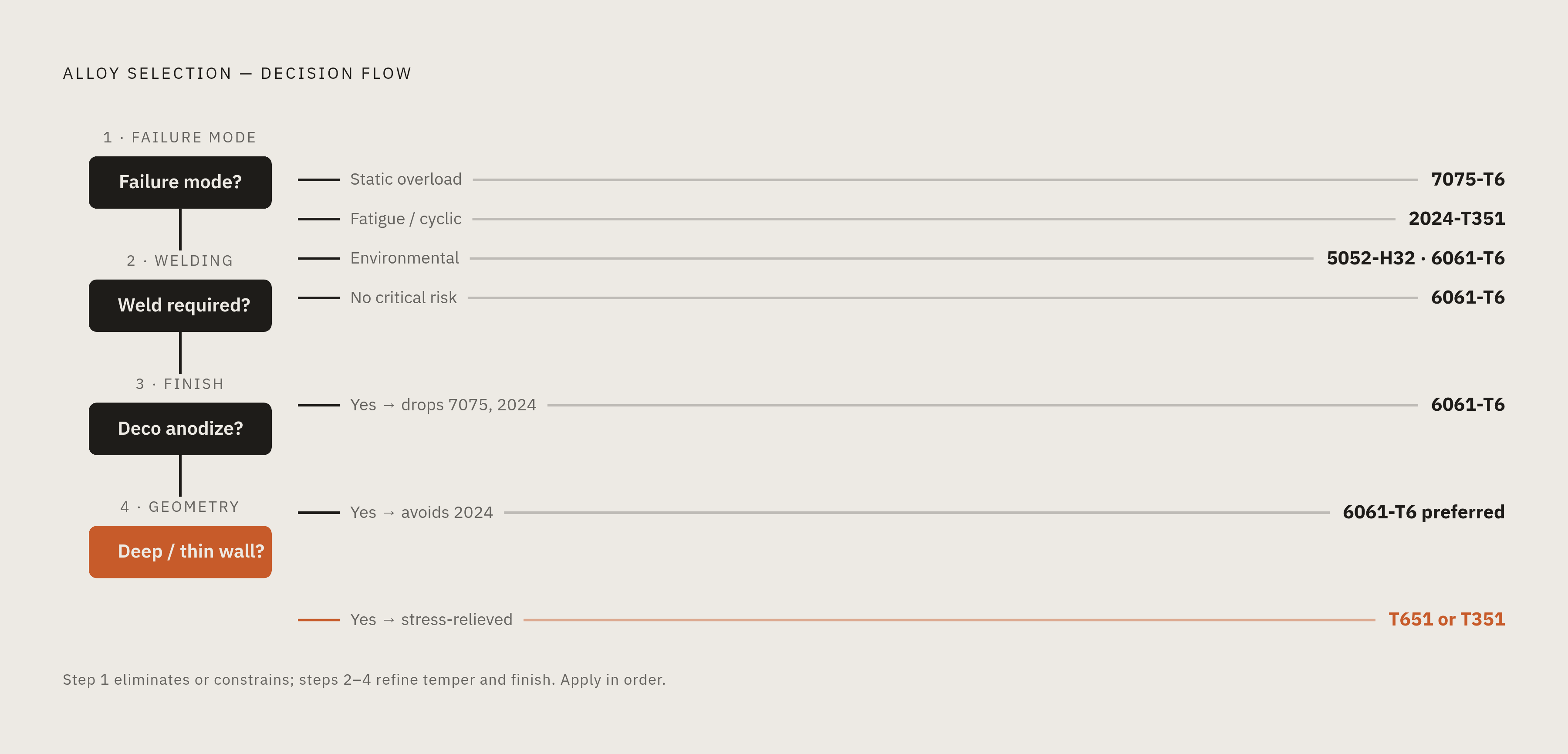
Start with the failure mode. Is this part going to fail from static overload, from fatigue cycling, from environmental degradation, or is none of those a serious risk at the margins being designed for?
- Static overload as the governing risk points to a strength ceiling problem, and 7075-T6 is the answer.
- Fatigue and cyclic loading point to 2024-T351.
- Environmental degradation points to 5052-H32, or 6061-T6 if load demands are higher.
- If none of those apply with any real margin, the decision comes down to machinability and cost, and 6061-T6 wins.
Next question: does the part need to be welded? If yes, 7075 and 2024 are both out, and 6061-T6 becomes the structural, weldable default.
Then finish requirements. If decorative anodizing is required, 6061 is the strong preference, and 2024 should be avoided outright. If a coating or cladding system is acceptable instead, 7075 and 2024 stay on the table.
Last, look at geometry and material removal. Large plates, deep pockets, thin walls: these call for a stress-relieved temper, T651 for 6061 or 7075, T351 for 2024, to keep warping under control. And if the part in question is actually a tooling base or precision fixture rather than a load-bearing structural piece, MIC6 or 5080 cast plate is the right family to be looking at, not rolled bar or plate stock at all.