Tube Bending Process Selection for Structural and Fluid System Applications
Mandrel bending prevents collapse and distortion where pressure tubes need tight bends.
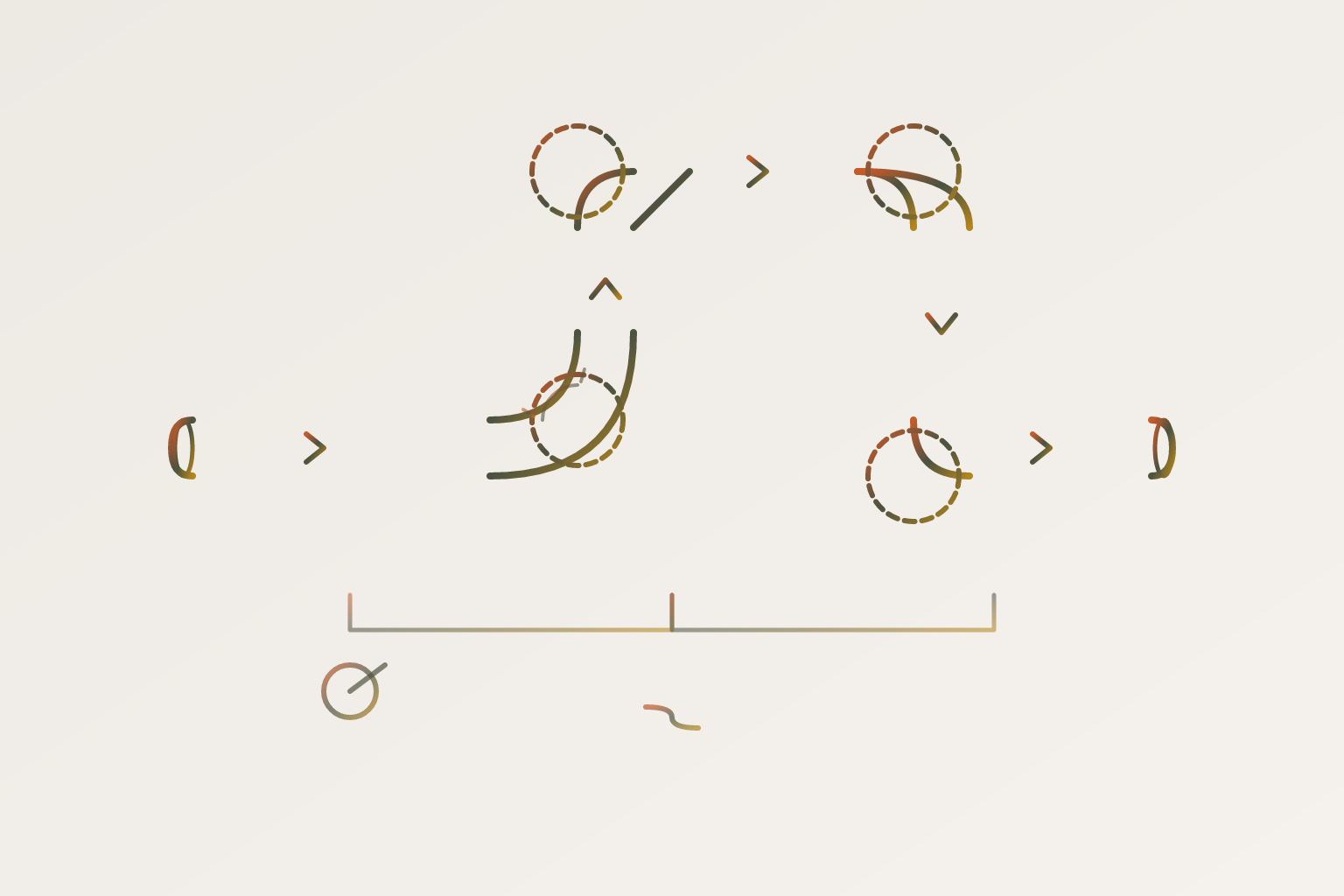
Tube bending comes down to matching four processes (rotary draw, mandrel, roll, and ram) against what the part actually has to do: carry load, hold pressure, or move fluid without leaking or restricting flow. Picking the wrong process makes the tube show it right away, through a collapsed wall, an oval cross-section where a round one belongs, or a torn-up inner surface that fails inspection before it ever sees service.
For a tube that must carry pressure without collapsing or going oval, mandrel bending is the correct choice in all but the most generous radius situations. Mandrel bending is rotary draw bending with a mandrel threaded through the tube's inside diameter during the bend, and of every metal-forming method available, it gives the tightest control over ovality and wall thinning. Wall thinning at the extrados cuts directly into burst pressure rating, making it a life-safety concern the moment the tube carries hydraulic fluid or fuel under pressure, and ovality cuts the effective flow area right where the tube bends. Roll bending and ram bending offer no internal support at all, so collapse and ovality risk climb sharply as radii tighten, and ram bending produces the most ovality and the least dimensional control of the four processes. Plain rotary draw bending without a mandrel is viable down to roughly 1.5D centerline radius on tubing with sufficient wall thickness, but below that threshold, or on any thin-walled tube with a high D/t ratio, mandrel support is required to hold wall integrity and cross-section geometry within pressure-rated tolerances.
Tubes and pipes aren't the same thing, even though the words get used interchangeably on shop floors. Tube is measured by outside diameter (OD) and shows up as fluid conduit, structural framing, and pressure lines. Pipe is measured by inside diameter (ID) and handles larger-scale transport, water mains, gas distribution, that kind of work. That distinction drives different tooling and different process choices from the first line of the drawing.
Bending spans every common cross-section, round, oval, square, rectangular, and it spans a wide material list too: aluminum, carbon steel, stainless steel, copper, brass, titanium, nickel alloys, superalloys, even PVC. Each one bends differently under stress, work-hardens at a different rate, and springs back by a different amount. Choosing a process based on habit or on whatever's cheapest that week is how shops end up with wall collapse, wrinkling, orange-peel surfaces, or dimensions that drift out of tolerance mid-run.
The four primary bending processes and what each one does to the tube
Rotary draw bending (RDB) is built around a die set with a fixed centerline radius. The tube gets clamped, then rotated around the bend die while a pressure die backs up the outer wall. A programmable indexing table lets a single part carry multiple bends in different planes without being re-fixtured. RDB handles round, oval, square, and rectangular tubing from around a quarter-inch up to 2 inches OD, across carbon steel, stainless, aluminum, and nickel alloys. It's widely treated as the dominant process for precision work, one industry source (CRD MFG) puts its market share at 39.1% across process types, though that figure isn't listed on GlobalSpec, so treat it as directional rather than gospel. Even RDB isn't magic on its own: without something supporting the tube from the inside, the outer wall of the bend (the extrados) thins out and the inner wall (the intrados) risks wrinkling once the radius gets tight. That's exactly the gap mandrel bending exists to close.
Mandrel bending is really RDB with a piece of tooling threaded through the tube's ID during the bend. That mandrel resists collapse and wrinkling from the inside, and a wiper die sitting right at the tangent point knocks down whatever wrinkling tendency remains on the intrados. With that support in place, centerline radii can drop to 1X the tube's OD, and some mandrel setups push that down to 0.7X OD. Compare that to roughly 1.5D as the practical floor without any internal support, and the value of the mandrel becomes obvious. Mandrel work typically covers tube sizes from about ¾ inch to 2 inches OD, across round, oval, ellipse, square, and rectangular profiles. Of every metal-forming method available, mandrel bending gives the tightest control over ovality and wall thinning.
Roll bending, sometimes called three-roller or pyramid roll bending, runs the tube through three powered rollers arranged in a triangle. Each pass tightens the curve a bit more. There's no internal support anywhere in the process, the inside of the tube is on its own the entire time. That makes roll bending well-suited to large, smooth, continuous curves, and poorly suited to tight radii or sharp angular bends. It occurs most often on pipe or heavier-wall tubing, where the section is thick enough that unsupported bending doesn't collapse it.
Ram bending, also called compression or press bending, pushes the tube against fixed dies using a ram. No internal support, no clamp die traveling along with the bend. It's the fastest method on the list and the cheapest to tool up for, but it also produces the most ovality and the least dimensional control of the four. That tradeoff makes sense for construction conduit, simple brackets, and other low-tolerance work where speed and tooling cost take priority over precision.
Which geometry and wall variables determine whether a process can hold a pressure tube's shape through the bend?
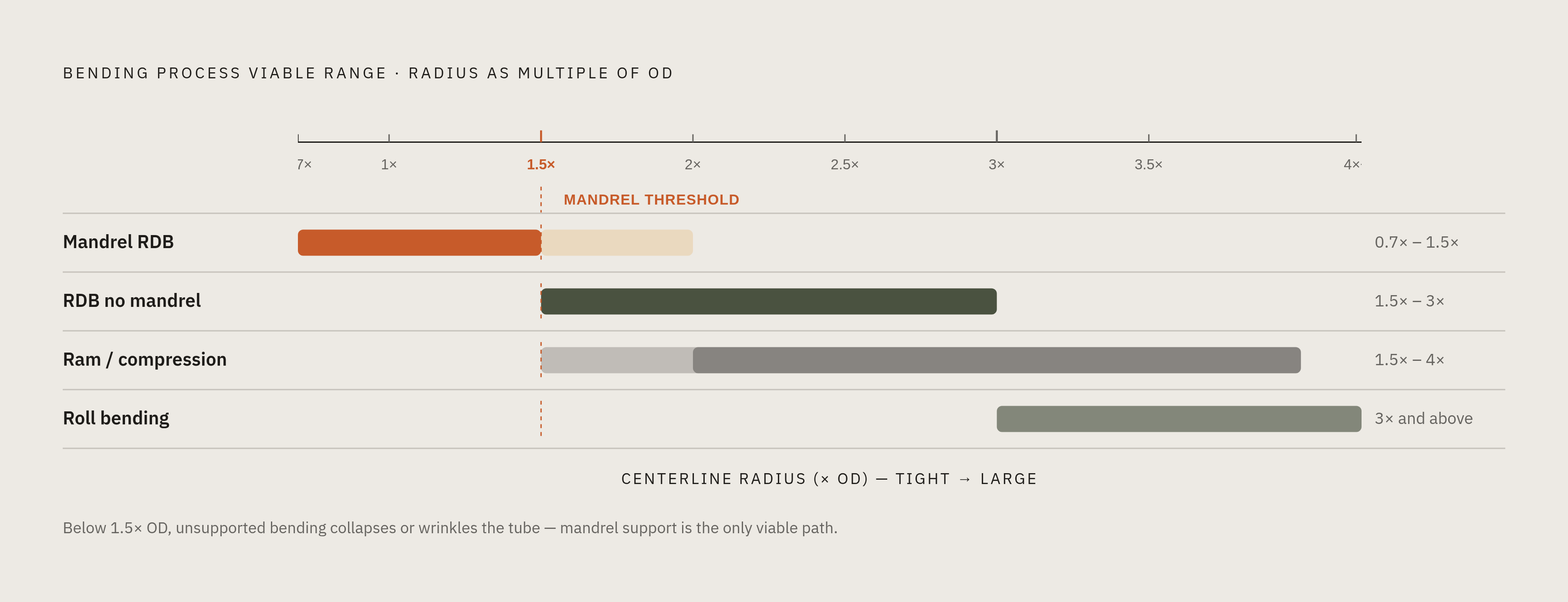
Centerline radius relative to OD, expressed as a multiple like 1.5D or 3D, is the single biggest gate on which process is even possible. Ram and compression bending are best suited to gentler curves, and collapse risk climbs fast without internal support as radii tighten. Roll bending performs well above 3D too, and below that threshold, ovality creeps up and control gets shaky. RDB without a mandrel can reach down to roughly 1.5D, below which collapse and wrinkling risk grows substantially without internal support. With a mandrel, RDB reaches 1D as a matter of course, with specialized setups getting to 0.7X OD.
Wall thickness relative to OD, the D/t ratio, matters just as much. A tube with thin walls relative to its diameter (high D/t) carries more collapse and wrinkling risk, and that pushes the mandrel requirement in sooner. Thicker-walled tubes tolerate unsupported bending longer. That is why ram and roll bending stay viable options on heavier stock even at moderately tight radii.
Ovality, the flattening or distortion of the round cross-section during a bend, occurs in every unsupported process to some degree. Mandrel bending controls it best. That matters enormously in fluid systems, where the flow area through the bend has to stay close to nominal, and it matters in structural tubes too, where an oval section carries load differently than a round one.
Wall thinning follows a predictable pattern: the extrados stretches and thins, while the intrados compresses and either thickens or wrinkles. Thinning isn't just a cosmetic issue. It cuts directly into burst pressure rating, which turns it into a life-safety concern the moment the tube is carrying hydraulic fluid or fuel under pressure.
Structural applications: what the geometry and load path demand from a bent tube
Structural tube bending covers a wide range: roll cages, chassis tubes, handrails, architectural metalwork, frame members, infrastructure components. Tolerance and radius requirements swing widely across that list, so the process decision has to follow the specific part.
Wall integrity at the bend is the first concern. Thinning at the extrados reduces the tube's cross-sectional strength and its resistance to buckling, so any thinning has to stay inside the margins the design allows for. Dimensional repeatability matters just as much, especially in weldments and frames, where bend angle and centerline radius need to stay consistent from part to part or the assembly simply won't fit. Running enough parts causes small variations to stack into real problems.
Ovality plays a structural role. Excess ovality reduces the tube's moment of inertia and shifts its section modulus, so the tube is weaker in bending than its nominal dimensions would suggest on paper. Surface finish tends to matter less here than in fluid systems, though weld prep areas still need consistent, predictable geometry to weld cleanly.
Roll bending finds its structural home in large-radius, continuous curves: architectural arches, curved handrails, structural rings, anywhere the radius sits above 3D and a smooth sweep matters more than tight angular precision. RDB owns the other end of the spectrum, roll cages, motorcycle and automotive frames, precision handrails, where tight angular control and repeatable centerline radius across multiple planes are the whole point. Mandrel support becomes necessary even in structural work when the tube's cross-section has to carry load straight through the bend without losing wall thickness where it counts.
Fluid system applications: where internal surface quality and wall integrity become pass/fail criteria
Fluid systems raise the stakes considerably: hydraulic lines, fuel lines, pneumatic circuits, process piping, medical tubing, high-purity semiconductor and biopharma supply lines, vacuum forelines. In this world, the inside of the tube matters as much as the outside, sometimes more.
Wall thinning at the extrados translates directly into a lower burst pressure rating, and high-pressure hydraulic systems are highly sensitive to uncontrolled wall thinning at a bend. Ovality cuts the effective flow area right where the tube bends, and in precision flow-control systems, a cross-section that's drifted away from circular changes the hydraulic diameter and throws off pressure drop calculations that engineers depend on.
Internal surface roughness is where things get unforgiving. High-purity systems, semiconductor processing, biopharma, demand inner-wall roughness at or below 25 μm Ra. Bending induces what the industry calls "orange peel" on the inner surface, a rough, textured finish that has historically made bent pipe unacceptable in high-purity service unless it goes through post-bend treatment. Weld joints introduce their own set of problems too: weld intrusions, metallurgical changes that weaken corrosion resistance, and surface disruptions that require additional post-weld processing. A bent run, done right, sidesteps all of that by eliminating the joint.
There's a documented path around orange-peel surface texture. Selecting tube stock with a grain-size number of 5 or greater, and bending to an appropriate radius, produces inner surfaces acceptable for high-purity use without any post-bend heat treatment or polishing. That approach has been validated in 304L and 316L stainless, the two materials that dominate high-purity fluid system work. Even the most demanding fluid applications can run on bent tube, provided the material spec, the radius, and the mandrel support all line up correctly.
When to specify a mandrel
A mandrel earns its place whenever the centerline radius drops tighter than roughly 1.5D, since collapse risk climbs sharply without internal support at that point. The same goes for thin-walled tube (a high D/t ratio), where unsupported bending wrinkles the intrados or flattens the extrados before the bend is even finished.
Mandrel support also becomes necessary when internal surface quality is part of the spec, since it cuts down the orange-peel effect on the inner wall, and whenever ovality has to stay tightly controlled, whether that's a fluid system protecting its flow area or a structural tube depending on a round cross-section for its strength. Add pressure-rated lines and aerospace structural tubes to that list too, anywhere wall thinning limits are tight enough that unsupported bending can't reliably hit them. Thin-walled stainless, aluminum, and exotic alloys tend to need mandrel support sooner than carbon steel, simply because they carry less self-supporting rigidity through the bend.
A mandrel isn't needed everywhere, though. Centerline radii at or above roughly 3D on thick-walled tube are fine for roll bending without any internal support. Structural applications with loose ovality tolerance on thick-walled tube fall into the same category, and so does low-precision conduit or basic construction tube work, where ram bending gets the job done at a fraction of the tooling cost.
A wiper die works alongside the mandrel at the tangent point, and it's worth specifying at tight centerline radii, with wall thickness a key factor in that decision. Thin-wall tube at tight radii is the combination most likely to need one. Every OD and CLR combination needs its own matched die set, and mandrel tooling adds setup cost on top of that. For low-volume prototype runs with several different bend geometries, that tooling cost adds up fast.
Material behavior under bending narrows the viable process window
Aluminum is significantly lighter than steel, which is the whole reason it is heavily favored in aerospace structural tube work and accounts for a notable share of tube bending projects across industries generally. 6061-T6 delivers strong yield and tensile properties, with solid corrosion resistance, but it's an age-hardened alloy with very little work-hardening capacity left in the T6 temper. Pushing it toward a tight centerline radius makes it more likely to crack than to keep hardening gracefully. When geometry demands a tighter bend, O or T4 temper offers more room to work with. 6063-T5 and 3003-H14 bend more easily and forgive more, though they trade away strength, which suits them to architectural work and lighter-duty structural parts. Springback in aluminum is moderate and predictable enough that CNC overbend compensation handles it reliably on RDB equipment.
Stainless steel makes up about 20% of tube bending projects. 316 stainless delivers 515 to 620 MPa tensile strength and stands out for chloride resistance, making it the default choice for marine environments, chemical processing, and high-purity fluid systems, the same 304L and 316L combination validated for bent high-purity runs. Stainless work-hardens fast during bending, and its springback runs higher than carbon steel's, so overbend compensation isn't optional, it's required. Grain size matters here too: a grain-size number of 6 or greater is associated with avoiding orange-peel on the inner surface, and applications headed for electropolishing or high-purity service want grain size 8 or finer still.
Titanium brings a strength-to-weight ratio about 40% better than steel. Grade 5 (Ti-6Al-4V) hits 895 MPa tensile, but it costs 15 to 20 times more than steel, which limits its use to select applications. Ti-3Al-2.5V, ASTM Grade 9, fills a practical gap between lower-grade titanium and the more demanding Grade 5, and it's common in high-performance exhaust systems, motorsport, and aerospace. Titanium's plasticity improves noticeably at elevated temperature, so warm or hot forming techniquesisted bending is used for tight-radius titanium work in aerospace applications. Springback is a significant consideration in precision titanium bending, making careful process control essential, no shortcuts, no exceptions.