Engineering Plastics for CNC Machined Parts in Mechanical Systems
Selecting the right plastic means filtering by load, temperature, moisture, and cost—in that order.

Picking an engineering plastic for a CNC machined part is a process of elimination. It's a process of elimination, run in a specific order, where each filter, mechanical load, thermal range, moisture exposure, and chemical environment, knocks out entire families of material before the next one even gets applied. Get the order wrong, or skip a filter because a material "looks fine" on paper, and the material that survives prototyping fails in the field. Material selection is arguably the single most consequential decision in part design: pick wrong and you pay for it twice, once in the failed prototype, and again when the redesign eats into a production schedule.
Before opening a materials database, five questions need answers, in this order: What loads does the part see? What environment does it run in? What are the dimensional requirements? What are the weight limits? And what does the part need to cost at volume? Each answer trims the candidate list before the next question even gets asked. This piece walks through the first four of those filters (load, thermal, moisture, chemical) and then shows how they stack up against a handful of real-world part types.
Filter one: mechanical load type
Load type comes first because it sets a floor. No amount of thermal resistance or chemical inertness rescues a material that can't survive the basic mechanical demand of the job.
Static load, like sustained clamping pressure, comes down to creep resistance. A material that cold-flows under constant stress is out, no matter how good its tensile strength looks in a headline spec. Cyclic or fatigue load, the kind found in reciprocating mechanisms, snap fits, and living hinges, cares about the fatigue endurance limit far more than ultimate tensile strength. Impact load, think housings, guards, and handles that get dropped or knocked around, is governed by impact strength above everything else. And sliding or wear applications, gears, bushings, cams, valve seats, are decided by friction coefficient and wear rate, with the hardness of the mating surface playing its own role.
Mapping common plastics against those categories tells most of the story right away:
- POM (Delrin) combines fatigue resistance with low friction, which makes it a natural fit for gears, bearings, and precision linkages. It's a poor pick where impact is the main threat.
- Nylon PA66, with tensile strength around 82 MPa, brings toughness and wear resistance to bushings and structural parts that see both impact and sliding contact. It runs into trouble when dimensional stability under fatigue has to coexist with moisture exposure. The next filter addresses that.
- Polycarbonate has the highest impact strength of the standard engineering plastics, so it shows up in guards, safety shields, and housings. It's not a wear material.
- PEEK, with tensile strength above 100 MPa and excellent fatigue and creep resistance, is the candidate when high mechanical load has to survive a harsh environment at the same time. PEI (Ultem), at roughly 105 MPa tensile, sits nearby on the strength scale.
- ABS handles low-to-moderate static and impact loads fine in non-precision, non-thermal parts, but gets eliminated fast once loads get serious.
- PTFE has low tensile strength, around 35 MPa, which disqualifies it from any load-bearing role. It survives this filter only in sealing and bearing-liner jobs, where the load is compressive and modest.
The sliding and wear case is where engineers most often under-specify. It's tempting to pick a material by its tensile strength on the spec sheet, when wear rate and compatibility with the mating surface are what actually decide the part's lifespan.
Filled grades offer a path to more load capacity without changing material families. Glass-filled nylon (GF30) can reach tensile strength near 180 MPa, and carbon-filled PEEK (CF30) raises stiffness and load capacity well past the unfilled base resin. Both come back up under the thermal and cost filters below.
Filter two: the service temperature ceiling is a hard cutoff, not a soft guideline
A material pushed past its continuous service temperature doesn't fail gracefully. It creeps, it loses dimensional accuracy, or it fails structurally. There's no "close enough" here, and treating a temperature ceiling as a rough guideline is how parts end up warped six months into service.
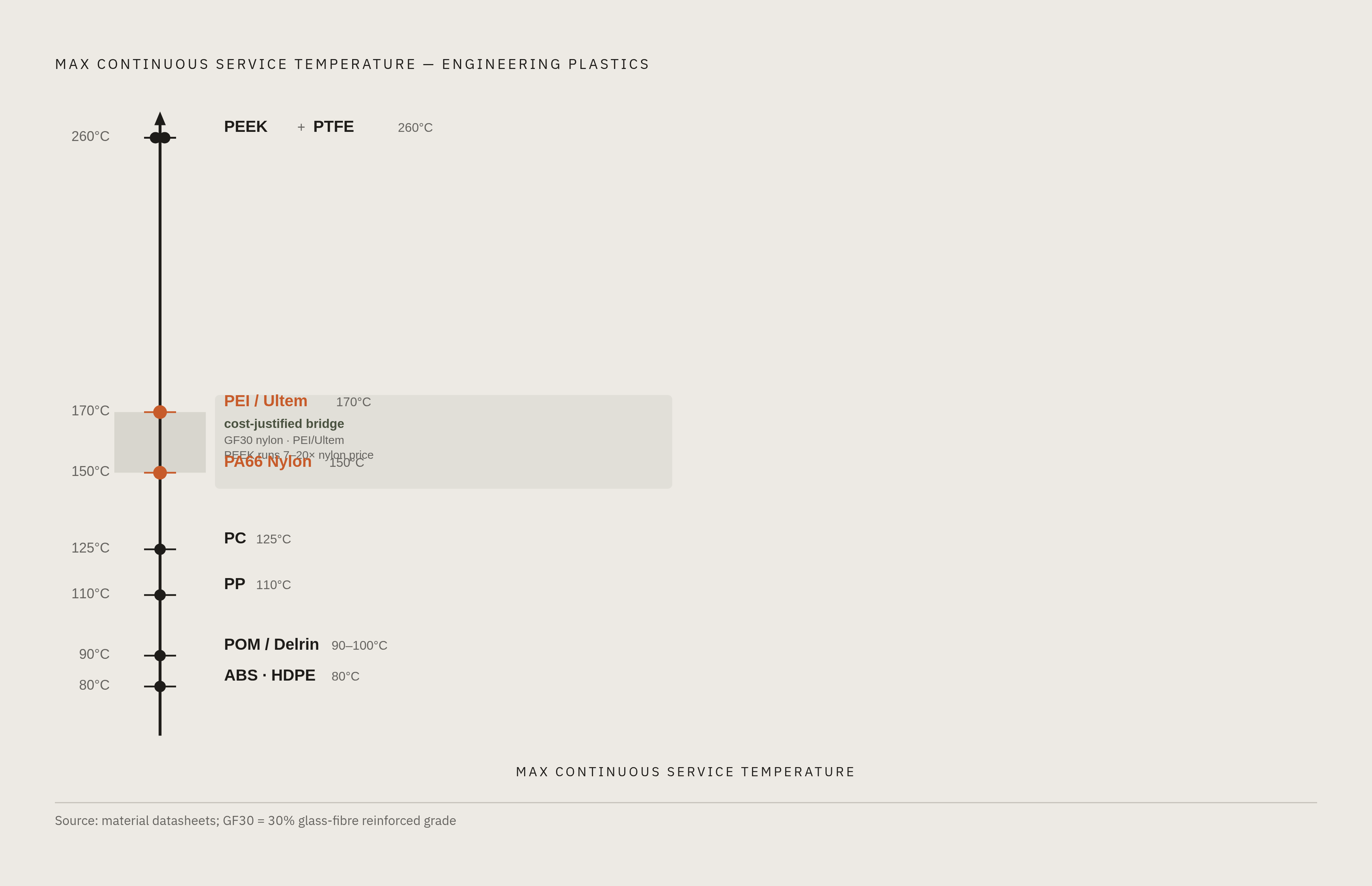
Laid out on a ladder, common engineering plastics separate cleanly by their max service temperature. ABS and HDPE both top out around 80°C, ruling them out for anything with real thermal excursions. POM/Delrin runs from about 80 to 105°C depending on grade, typically 90 to 100°C for unfilled homopolymer, which covers most room-temperature mechanical systems but not an engine bay or process equipment. PP reaches 110°C, PC reaches 125°C. Nylon PA66 climbs to 150°C, though moisture absorption (covered next) can shift dimensions before temperature ever becomes the limiting factor.
PTFE tops out at 260°C, a ceiling that matches PEEK, but its mechanical strength is too low for most structural roles, so it stays confined to sealing duty. PEI (Ultem) runs continuously at 170°C and comes with inherent flame retardancy built in, making it a solid, cheaper stop between PA66 and PEEK for anything in the 150 to 200°C band. PEEK itself runs continuously at 260°C, with a melting point near 343°C, and is the material of record for aerospace brackets, medical implants, and downhole oil and gas tooling.
That 150 to 200°C window is exactly where the cost argument gets sharp. A high-performance engineering polymer can run 7 to 20 times the cost of POM or nylon, so glass-filled nylon (GF30, rated to roughly 180°C) becomes the sensible bridge for anything that doesn't actually need that top-tier level of performance.
Filled grades deserve a second look here too. GF30 nylon and CF30 PEEK raise stiffness and thermal conductivity, but they don't meaningfully push the continuous service temperature ceiling higher. Unfilled and filled PEEK share roughly the same continuous service temperature, near 250°C, yet the filled grade's heat deflection temperature (HDT) jumps to somewhere around 315 to 336°C, compared to roughly 152°C for unfilled PEEK. That's a real advantage under load, but the lever being pulled is stiffness. A spec sheet making filled grades sound like a straight thermal upgrade is pulling the stiffness lever, not adding heat resistance on its own.
Filter three: moisture absorption and its consequence for dimensional accuracy
Moisture absorption gets skipped more than any other filter, mostly because its effect is invisible at the design stage. Dimensional drift on a shelf, or a documented sourcing failure once parts are already in the field, occurs later because moisture absorption's effect is invisible at the design stage.
The classic version of this mistake: an engineer specs PA66 nylon purely for its wear resistance, without accounting for the fact that it absorbs 2 to 3% moisture at equilibrium, which causes measurable dimensional change on precision features. That's not a hypothetical edge case; it's a documented failure mode in machined nylon parts. On a feature that needs to hold ±0.05 mm or tighter, nylon has to be pre-conditioned and kept in sealed bags until the moment it goes on the machine, or the entire tolerance budget gets eaten by ambient humidity before the part is even installed next to its mating piece.
POM/Delrin is at the low end when ranked by moisture absorption. It holds ±0.015 to 0.025 mm on diameters without any special handling, making it the most dimensionally trustworthy engineering plastic for precision fits. PTFE absorbs almost no moisture at all and stays chemically inert to water and aqueous solutions. PEEK also absorbs very little, another reason it shows up in implant-grade and fluid-handling parts. Polycarbonate absorbs little moisture too, but watch for stress cracking in humid conditions if machining left residual stress in the part. Nylon (PA6/PA66) is at the high end, 2 to 3% at equilibrium, and needs explicit dimensional allowance or conditioning on anything precision-fit. ABS falls in the moderate range: fine for a functional prototype, not something to trust on a precision assembly in a humid plant.
Filter four: broad chemical resistance is not a single property
"Chemical resistance" gets treated as one line item on a spec sheet, but it's really three separate questions bundled together, and conflating them is how the wrong material slips through. There's resistance to organic solvents (cutting fluids, lubricants, fuels, cleaners), resistance to aqueous acids and alkalis (process chemicals, sterilization agents), and then FDA or biocompatibility compliance for food and medical contact. A material can pass one and fail another.
On the solvent side, PTFE resists virtually everything and sits at the top of the chemical inertness tier. PEEK resists most solvents too, rated "excellent" on most comparison charts, and becomes the pick when mechanical load or temperature has already ruled out PTFE. Polycarbonate is only moderate here: it's prone to stress cracking around a range of common solvents and chemicals. Through-coolant or an air blast during machining keeps PC from crazing on the shop floor, but that doesn't help once the part is in service around the wrong chemical. POM/Delrin handles fuels, alcohols, and many solvents well, but strong acids and oxidizers take it out. Nylon resists a decent range of solvents but degrades in strong acids, so it's off the table for acidic process environments. ABS is moderate at best and gets eliminated fast in any solvent-heavy application.
Food contact and biocompatibility form their own sub-filter. For food-contact parts, HDPE, POM (specifically the Delrin FG100 NC010 grade), PET, and PP all come in grades certified to a food-contact regulatory standard, but the certified grade has to be confirmed before ordering, since "FDA-compliant HDPE" and plain "standard HDPE" are not interchangeable on a spec sheet even though they look like the same material. For medical implants and sterilization, PEEK with ISO 10993 biocompatibility certification and autoclave stability is the standard choice; for non-implant medical contact, certain FDA-certified grades of PC, nylon, and POM apply instead.
The choice between a high-performance engineering polymer and another fluoropolymer is a good illustration of why these filters have to run in order. Both survive extreme chemical environments, so the chemical filter alone can't pick a winner between them. But PTFE's 35 MPa tensile strength already knocked it out of any structural role back at the load filter, so by the time chemical resistance gets evaluated, that decision has already been made.
How the four filters converge on a shortlist: common application archetypes
Running these filters in sequence against real part types shows how fast the candidate list shrinks, often down to one or two materials by the third filter.
A precision gear or bearing in a dry, room-temperature assembly. The load filter (sliding/wear) keeps POM, nylon, and PEEK on the list, and drops PC and ABS immediately. Thermal doesn't eliminate anything at room temperature. Moisture does the real work here: nylon's 2 to 3% absorption disqualifies it unless the material gets conditioned first, while POM sails through, holding ±0.015 to 0.025 mm with no special handling. No aggressive chemicals are involved, so the chemical filter doesn't touch the list further. POM/Delrin wins, and within Delrin's own grade lineup, Delrin 570 gives the highest stiffness, Delrin 100 favors toughness and impact, and Delrin AF (PTFE-filled) is built for dry bearing and sliding contact specifically.
A structural bracket or manifold running at 150 to 200°C. The load filter favors PEI (Ultem) here, since its creep resistance matters directly for a manifold holding sustained pressure. Thermal is where the real elimination happens: ABS, POM, PC, HDPE, and PP are all out, PA66 nylon barely clears the low end of the range, and GF30 nylon, PEI/Ultem, and PEEK all survive. Cost settles it from there. PEEK running 7 to 20 times the price of nylon or POM makes GF30 nylon or PEI/Ultem, at 170°C continuous service, the defensible choice as long as temperatures stay under 200°C. PEEK gets reserved for the upper end of that range or for jobs where chemical resistance is also a hard requirement.
An impact-resistant guard or safety shield that also needs to be transparent. The load filter (impact) keeps polycarbonate on the list right away, while acrylic (PMMA) falls behind it on raw impact strength. Once transparency enters the picture alongside the impact requirement, PC's combination of high impact strength and optical clarity is what carries it through, a pairing few other engineering plastics can match at the same time.