Stainless Steel Grades for Custom Machined and Fabricated Parts
Pick the right grade or watch savings vanish in salt spray and recalls.
Grade choice for a stainless part comes down to three separate questions that rarely share an answer: how the material behaves under a cutting tool, how it behaves in a weld puddle, and how it behaves five years into service. Get the third one wrong and the first two don't matter. A Canadian marine equipment manufacturer found that out the hard way: fittings spec'd in 304 to save a few dollars per part started showing real rust within a year of sitting in salt spray, and the product got recalled. Switching to 316L fixed it, and those parts are still holding up five years later. That's the whole argument in one story: pick the wrong grade and the "savings" evaporate the moment rework, scrap, or a recall appears on the invoice.
304 stainless lacks molybdenum, which is what gives a grade real resistance to chloride attack and salt spray. For marine fittings, 316L is the correct grade: the molybdenum addition provides that chloride resistance, and the lower carbon content reduces the risk of intergranular corrosion in heat-affected zones if any fittings get welded during assembly. A Canadian marine equipment manufacturer ran exactly this failure mode, with 304 fittings showing rust within a year in salt spray before a recall, and the same parts in 316L have held up for five years since the switch. Expect to pay 20 to 50% more than 304 for 316L, and if any fitting is welded without post-weld solution annealing, 316L is the safer call over standard 316 with no real exception.
Stainless steel earns the name because of one thing: at least 10.5% chromium content, which forms a thin oxide layer on the surface that keeps rust from taking hold. Adding nickel makes the alloy more ductile. Adding molybdenum makes it hold up dramatically better against acids and chlorides, in some environments up to four times more resistant than plain carbon steel. From there, stainless splits into five structural families. Austenitic is the one people mean by default when they say "stainless," non-magnetic and prone to work hardening. Ferritic is magnetic, cheaper, and less corrosion resistant. Martensitic can be heat treated to real hardness but turns brittle in the process. Duplex mixes properties for high strength in nasty environments. Precipitation-hardening grades reach very high strength after an aging step. Each family trades off machinability, corrosion resistance, weldability, and hardenability differently, and those four traits are what actually drive a grade decision, not brand familiarity or habit.
The five grades that appear most often in custom machined and fabricated work, and what each offers
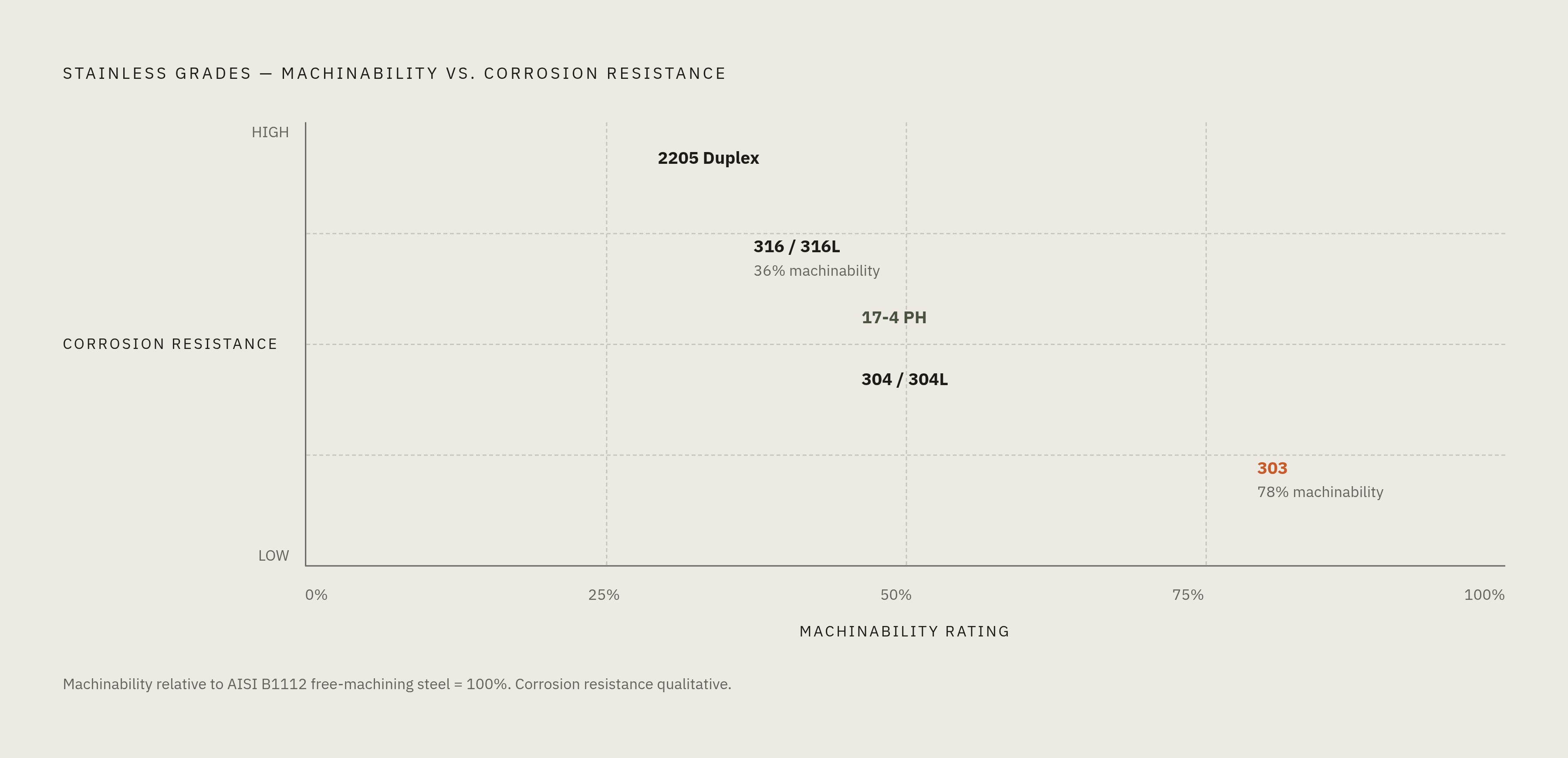
303 is the free-machining grade. It carries at least 0.15% sulfur, which forms manganese sulfide particles that act like built-in chip breakers. That gives it a machinability rating around 78% and produces short, clean chips that don't gum up a CNC spindle. But 303 isn't just a faster version of 304. That same sulfur chemistry that makes it easy to cut also limits it in corrosion-critical work, in welding, and in anything with tight downstream quality controls. It's the right call for fasteners, fittings, and high-volume turned parts where a faster cycle time is more important than saltwater resistance or a clean weld bead.
304 and 304L are the workhorse grades, the ones most people picture first. They're affordable, easy to source, and fine for indoor use or mild exposure. Machinability is around 45%, which is a real step down from 303: the material is gummy, and if a tool dwells too long it work-hardens fast and chews through inserts. Mechanically, 304 runs about 99 ksi ultimate tensile strength, 52% elongation, and 85 HRB hardness. It's a good fit for kitchen equipment, brackets, covers, and enclosures. It is not a good fit for salt water or aggressive chemicals, full stop.
316 and 316L are the upgrade path when corrosion resistance actually matters. The molybdenum addition gives real resistance to chloride attack, salt spray, and a wide range of chemical exposure. The tradeoff is machinability around 36%, even tougher than 304. This requires high-torque machines and slower cutting speeds. Mechanically it runs about 85 ksi UTS, 56% elongation, 81 HRB hardness. 316L's lower carbon content matters specifically for welded parts: it cuts the risk of intergranular corrosion in the heat-affected zone after welding. If a part gets welded and can't be solution-annealed afterward, 316L is the safer call over standard 316. Expect to pay 20 to 50% more than 304 for it, based on Xavier's pricing data, and that premium is usually worth it for marine hardware, coastal equipment, chemical plant parts, and food or pharmaceutical assemblies.
17-4 PH solves a different problem: high strength without sacrificing reasonable corrosion resistance. In its annealed state it machines about like 304, so the standard approach is to machine it soft, then age-harden it afterward. Aged to the H900 through H1150 condition, strength climbs to somewhere in the 150 to 190 ksi range depending on the heat treat; exact properties vary by heat treat condition within that range. Once it's aged, machining gets much harder, so every significant cut, drill, or tap needs to happen before that aging step, not after. It appears in aerospace gears, valves, and structural brackets that need real strength.
2205 Duplex is the high-strength structural option for severe environments, rated for service up to 300°C. It's stronger and harder than 304 or 316, though not as hard as aged 17-4PH among the grades that see regular CNC work. It cuts harder too: higher forces at the tool, faster wear, and it demands rigid equipment running at lower speeds. It can be cold-formed by bending and pressing, but its higher yield strength means more springback and higher press tonnage than an austenitic grade needs. Oil and gas equipment, pressure vessels, and structural parts in aggressive service are where it earns its keep.
Two more grades deserve a mention for narrower use cases. 440C martensitic delivers the highest hardness of any stainless grade along with solid corrosion resistance and excellent wear resistance, useful anywhere surface hardness is more important than toughness or weldability. 316Ti is a titanium-stabilized variant of 316, noted for elevated-temperature applications in demanding environments.
As a starting rule: 304 for ordinary environments, 316 for corrosive ones, 316L whenever welding enters the picture. That's a starting point, though, not the whole decision, and the rest of this piece explains why.
Why stainless steel is genuinely difficult to machine
Two properties make stainless a pain at the spindle. It has low thermal conductivity, so heat generated by cutting stays trapped at the tool edge instead of dissipating into the chip. And it work-hardens: the harder you push it, the tougher it gets right where the tool is trying to cut. Put those together and stainless wears out cutting tools roughly three times faster than aluminum does, based on CNCPioneer's machining guide.
The fix is a set of specific, learnable parameters, not guesswork. CNCPioneer's 2026 data recommends feeds of 0.05 to 0.1 mm/rev for 304, surface speeds of 100 to 150 SFM for austenitic grades generally, and high-pressure coolant at a minimum of 70 bar to pull heat away from the cut. Rigid fixturing cuts vibration by roughly 50%, which matters more with stainless than with almost any other common metal because chatter accelerates work hardening. Annealing 316L before machining improves its machinability by about 20%, a decision that gets made at the design or spec stage, long before a part ever hits the mill.
Tooling needs to match the grade, not just the machine. 303 cuts cleanly because its chips break easily, making it compatible with a wide range of carbide tooling. 304 and 316 do better with TiCN-coated end mills for roughing, and chlorine-based coolants should stay off the table with 300-series stainless because chlorine can trigger stress corrosion cracking. Water-based synthetic coolants are the safer default. 17-4 PH is machined before aging precisely because the hardened condition is far more difficult to cut, so operation sequencing matters. 2205 Duplex needs rigid setups and reduced speeds; running it with standard 304 parameters will burn through tooling fast.
When the process is dialed in correctly, CNC machining on stainless can hold tolerances within ±0.005 mm, tight enough to meet military-grade specs. But that number only happens when grade, tooling, and coolant strategy are all aligned. Machinability isn't a fixed number stamped on the material certificate. It shifts with heat treatment state, tooling choice, coolant, and machine rigidity. A grade that's harder to machine but specified correctly can end up cheaper to produce than an easier grade specified carelessly.
How sheet metal fabrication, welding, and multi-step workflows change the grade decision
Stainless sheet metal fabrication strings together cutting, forming, welding, machining, and surface treatment, and each step leaves a mark on the finished part, based on Xavier's process breakdown. Unlike a single-setup CNC job, tolerances in fabrication stack up across every one of those steps. Deciding upfront which tolerances belong to the fabrication stage and which belong to a later machining operation saves both cost and scrap.
Laser cutting is the default for flat profile work. It holds tolerances as tight as ±0.127 mm and handles material up to 20 mm thick, but it leaves a heat-affected zone at the cut edge, and that zone hardens locally. Forming stainless comes with its own rulebook. Minimum bend radius needs to be a multiple of material thickness larger than what mild steel needs, because stainless work-hardens faster than mild steel does; mild steel usually gets away with a smaller multiple of thickness, so this is a real spec difference, not a rounding error. Hole placement near bends also demands extra margin given stainless's work-hardening tendency. Grain direction matters too: bending perpendicular to the grain cuts cracking risk. Keeping bends on the same plane and in the same direction saves setup time, and standardizing bend radii across a part avoids extra tooling changes, especially in thicker material where tight radii are hard to hold. Press brake forming needs three-point contact to come out accurate; two-point contact leaves the flange deformed.
Welding is where grade choice and process choice collide hardest. 303's sulfur content, the same thing that makes it easy to machine, makes it a poor candidate for welding, since sulfide inclusions can cause defects in the weld. 316L exists largely because of this problem: its lower carbon limit was engineered specifically to reduce sensitization risk in the heat-affected zone, since welding standard 316 without that lower-carbon version can quietly damage corrosion resistance right where the weld sits. So if an assembly can't go through post-weld solution annealing, 316L is the safer spec over 316, no real exception. 2205 Duplex can be welded too, but only with controlled heat input and the right filler metal, or the duplex microstructure that gives it its strength starts to break down.
Multi-step workflows make all of this compound. A part that's laser-cut, formed, welded, and then finish-machined has to satisfy the most restrictive requirement at every single stage, and the grade that's ideal for machining is often not the grade that's ideal for welding. That conflict needs resolving before the bill of materials gets frozen, not after. And once a part has been machined, welded, or formed, passivation, governed by ASTM A967/A967M-25, restores the passive oxide layer that those operations disturb. Not every grade responds to passivation the same way, which is one more reason grade and process need to get decided together.
What design for manufacturability decisions reduce cost and scrap in stainless parts?
DFM isn't a review that happens after a design is done. Most of a part's production cost gets locked in by decisions made before the BOM is frozen. Bringing manufacturing input in early catches non-standard tooling needs, flags tolerances that quietly trigger secondary operations, and finds places where weld joints can be consolidated instead of multiplied.
On the CNC side, a handful of features drive most of the cost and scrap risk in stainless. Deep holes need through-spindle coolant to clear chips, and peck drilling cycles keep the bore from work-hardening mid-cut. Thin walls are a real deflection risk given how fast stainless work-hardens, so fixturing and toolpath strategy need to be planned alongside wall thickness, not bolted on afterward. Sharp internal corners force small-diameter tooling and slow feeds, so matching radii to tools that already exist in the shop saves both cost and cycle time. Small threads are more vulnerable to breakage in work-hardening grades and should only show up where they're functionally necessary. Tolerances matter here too: standard tolerances keep cost down, and precision tolerances that trigger secondary operations should only land on surfaces where the function actually demands it. Coolant access deserves the same attention as any dimension. Pocket geometry or blind holes that block coolant from reaching the cutting edge degrade finish and chew through tools faster.
Sheet metal carries its own DFM rules. The larger-multiple-of-thickness minimum bend radius isn't a suggestion; design tighter than that and expect cracked parts. Holes placed too close to a bend line distort during forming, so leave real edge-to-hole distance. Fabricated tolerances run broader than machined ones by nature, so if a formed stainless enclosure needs a tight-tolerance bore, that bore belongs in a secondary machining step, not in the forming operation itself. Standardizing bend radii across a part, especially in thicker stock, cuts down on tooling changes and setup time.
Grade and DFM decisions can't really be separated. Spec 303 on a part that later needs welding, and no amount of process tuning fixes that mismatch after the fact. Spec 316 instead of 316L on something that gets welded without post-weld annealing, and corrosion risk appears right in the heat-affected zone. That is why 316L should be the default for welded assemblies. With 17-4 PH, every feature needs to get machined before aging; designing in a hole or thread that requires drilling after the age-hardening step adds real cost and real risk. With 2205 Duplex, generous radii on formed features matter because the springback is higher than austenitic grades, and tight features just mean more scrap.
Getting DFM feedback at the quoting stage, the moment a file gets uploaded rather than after a first article fails inspection, is what actually lets a team catch these problems before material gets cut. Programs that build that feedback loop in early move faster and waste less.
How raw material lead times and vendor structure affect what grade you can realistically get
Grade selection doesn't happen in a vacuum where every alloy sits on a shelf ready to ship. Mill availability, distributor stock levels, and order minimums all shape which grade actually arrives on time, and that reality belongs in the decision alongside metallurgy.
304 and 316 are the grades distributors stock in the widest range of shapes and sizes, since they cover the bulk of demand across industries. That breadth means shorter lead times in common bar, sheet, and plate sizes. Less common grades, like 2205 Duplex or 316Ti, or unusual shapes and thicknesses in any grade, often mean placing a mill order rather than pulling from distributor stock, and that shifts lead time from days to weeks. 17-4 PH in specific bar diameters or plate thicknesses can hit the same bottleneck, particularly when a project needs a heat-treat certification alongside the material itself.
Vendor structure matters just as much as the alloy. A shop that buys from a small number of local distributors will face tighter constraints on unusual grades than a shop with broader mill relationships. That difference can quietly override an engineer's first-choice grade: the metallurgically ideal spec doesn't help a program if it adds eight weeks to a schedule that has none to spare. Building lead time and grade availability into the sourcing conversation early, right alongside the corrosion, machining, and welding tradeoffs already on the table, keeps a good metallurgical decision from turning into a bad scheduling one.