Process Selection for First-Article Mechanical Prototypes
Choosing the right manufacturing process for prototypes matters more than meeting a deadline.
A pump housing gets machined from billet aluminum because the engineering team has a CNC vendor on file and a deadline in nine days. The part passes inspection, fits the mating components, and tells the team almost nothing, because the production version of that housing is a die casting, and a machined prototype can't confirm that a casting tool will fill those same wall sections without porosity or short shots. That's the core failure in first-article planning: process selection gets treated as a logistics detail, a question of who can turn a quote around fastest, instead of a strategic decision about what the prototype is actually supposed to prove.
Habit-driven selection matches a process to what the team already knows how to buy, not to the part's geometry, its material, its tolerance requirements, or the specific question the first article exists to answer. A prototype built this way can pass every inspection and still fail at its only job: confirming the part is producible the way it's meant to be produced. It answers a question nobody asked.
The fix is a sequence, not a checklist: geometry first, then material, then tolerance, then validation goal. Named in that order, before any process gets picked, these four inputs are what the rest of this piece works through.
The four inputs that determine the right process before any tool is cut
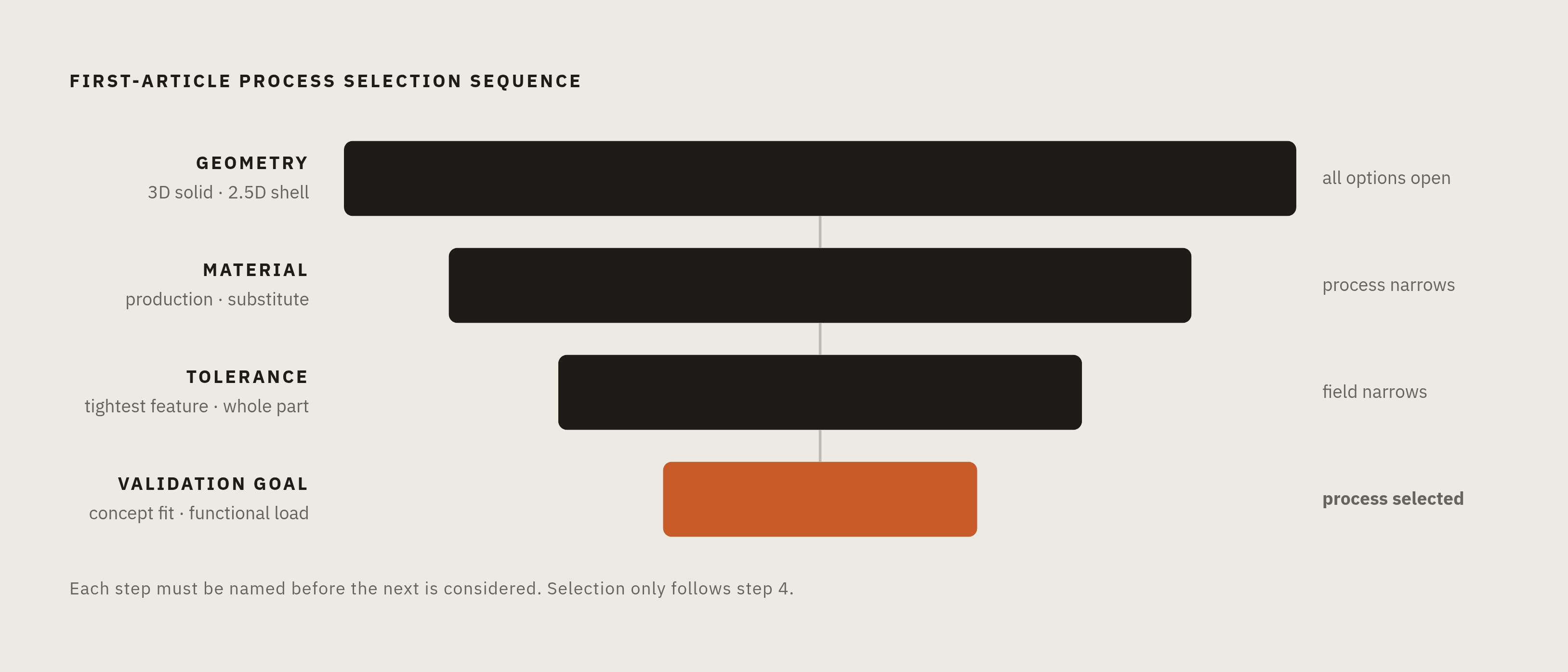
Geometry comes first because it narrows the field before anything else is even on the table. A part is either a true 3D solid, with pockets, bosses, threads, and free-form faces, or it's a 2.5D folded shell, like an enclosure, a bracket, or a panel. That distinction alone eliminates or favors entire process families before material or tolerance enters the conversation.
Material comes next, and it can override what geometry suggested. The production material isn't always the right prototype material. A part headed for high-volume die casting is often better prototyped in a wrought alloy on a CNC machine. A part headed for titanium production is often better first-articled in 6061 aluminum, which cuts fast and lets a team iterate before committing to a material that's expensive and slow to machine.
Tolerance sets the precision floor. Not every feature on a part needs the same level of control, and the process that suits the bulk of an assembly isn't necessarily the process that suits its tightest feature. Isolating that one feature, rather than letting it dictate the process for the whole part, is itself a design decision worth making early.
Validation goal adjudicates everything that's left. Concept confirmation, does it fit, does it look right, tolerates far more process latitude than functional testing, does it hold pressure, carry a load, survive a duty cycle. Choosing a process that nails function when the goal was only fit wastes time and money. Choosing a process that only confirms fit when the goal was function produces a prototype that can't answer the question that mattered.
Manufacturing constraints work best when they enter at the concept stage, before geometry is frozen on a drawing. These four inputs are the mechanism for that: a sequence that forces the manufacturability conversation to happen early, while it's still cheap to change course.
When CNC machining is the correct answer
CNC earns its default status under a specific combination: a true 3D solid, a material that needs tight tolerance control, and a validation goal tied to functional performance. Pockets, bosses, threads, and free-form faces that can't be produced by bending or casting belong on a machine. So do tolerance requirements that only subtractive machining can reliably hold, and low-volume runs where no tooling investment makes sense.
Aluminum 6061-T6 is the material that makes this work. It machines cleanly, holds a strong strength-to-weight ratio, keeps tolerance well through a cutting program, and anodizes without complication. That's the reason 6061 stands in for titanium at the first-article stage: a team can iterate fast on an easy-to-cut alloy before committing to a material that's expensive and slow to remove.
CNC stops being the right call the moment the part is fundamentally a 2.5D folded shell. Enclosures, brackets, and panels are sheet metal parts by geometry, and machining them from billet wastes material, drives up cost, and returns a prototype that never touches the process the design is actually headed toward.
Volume sets a rough boundary too. CNC suits runs from one part up to a few hundred, with no tooling required to get started. Past that threshold, the economics of casting or stamping start to win, and a CNC prototype of a part destined for one of those processes can't speak to whether that production path will actually work. Where a single feature on an otherwise different-process part genuinely needs precision sheet metal or casting can't deliver, the better move is machining that one feature as a discrete component, not converting the whole assembly to CNC to chase it.
Sheet metal fabrication as the right process for shells, enclosures, and brackets
Sheet metal fabrication earns its place on geometry, not on price. Laser or punch cutting followed by bending, rolling, and welding is how enclosures, brackets, and panels get made in production, and that sequence can't be replicated by machining the same shape from billet. A machined enclosure prototype can look identical to the sheet metal version and still tell a team nothing about whether the real part will assemble and seal correctly.
Tolerance in sheet metal is appropriate for enclosures and structural brackets, not for features that need precision machining can deliver. Where one feature in a sheet metal assembly genuinely needs tighter control, the fix is a machined insert dropped into that one spot, not a decision to machine the entire part.
Alloy choice carries real weight here. Aluminum 5052 forms well and is the standard choice for sheet metal enclosures, though it machines less cleanly than harder grades when a tight-tolerance feature is involved. Aluminum 6061 machines cleanly but its formability is more limited, and tight bend radii in 6061 are more prone to cracking. Specifying the wrong alloy for a sheet metal first article produces failures that trace back to the material, not the design, and that confusion can send an iteration cycle in the wrong direction.
Lead time for sheet metal at prototype volumes runs close to CNC. The time penalty appears in finishing steps like powder coat and anodize, so they belong in the first-article schedule from the start. Standardizing to common gauges and bend radii cuts cost and lead time without giving up function, and that's a decision worth making at the design stage, not a concession made later under schedule pressure.
Where casting fits the first-article stage
A part headed for production casting should almost never be first-articled by casting itself. Casting earns its economics at high volume, where tooling cost gets spread across thousands of units. At prototype quantities that math flips, and CNC machining the same geometry comes back faster and cheaper.
That only works if the design already follows casting rules before it reaches the mill: draft angles, uniform wall thickness, sensible parting line placement. A CNC prototype of a casting-incompatible shape doesn't validate anything about the production part, because the production part will need a different geometry to cast correctly.
Tolerance compounds the risk. CNC machining holds tighter precision than casting does, so a CNC prototype of a casting-bound part will be more accurate than the shipped part. That gap can hide fit and function problems that appear only once the real casting process takes over.
Material choice follows the same logic as the CNC section above, applied to a different pairing: when the production part is cast aluminum, a wrought alloy on the CNC prototype is usually the more practical pick over a cast alloy. Wrought stock machines more cleanly and is easier to source in billet, so the prototype comes back faster and at better quality, even knowing the production material will differ.
Casting does belong in first-article work when the thing being validated is internal geometry no subtractive process can reach: channels, voids, undercuts buried inside the part. A sand or investment cast prototype, even at low volume, is sometimes the only way to confirm those features behave the way the design intends, because no other process can produce them to check.
3D printing's legitimate role in first-article work and its hard limits
3D printing is the right call when the validation goal is geometric fit, ergonomics, or spatial envelope, at low volume and high geometric complexity. Additive processes can produce shapes no subtractive or forming process can touch, and for goals like "does this assemble" or "does this fit the enclosure" or "does this feel right in a hand," the fact that the process doesn't match production is beside the point.
It fails the moment the goal shifts to functional testing. Printed material properties, anisotropy between layers, adhesion at the layer lines, porosity through the cross-section, don't match the properties of the production material. A printed part that survives a load test or a pressure test hasn't confirmed the production part will survive the same test; it's confirmed that the printed part did, which is a different fact.
A part that performs well printed can also hide constraints that only appear once it's redesigned for mass production. Additive doesn't reveal the wall thickness uniformity, draft angles, or flow paths that injection molding will demand, so a team relying on a printed first article alone can walk straight into a redesign at the production stage that nobody saw coming.
Carbon fiber composites sit in a parallel position, at higher stakes. Composite parts aren't machined from billet; they're laid up, cured, and trimmed, and for a one-off prototype, machined aluminum is almost always faster and cheaper to produce. Composites earn a place at the first-article stage only when specific stiffness or specific strength genuinely can't be met by aluminum or titanium, and the validation goal is exactly those properties, not a general stand-in for "lightweight and strong."
Specialty fabrication processes, tube bending, gaskets, and custom springs, at the first-article stage
Tube bending
Four parameters decide whether a tube bend can actually be produced: centerline radius (CLR), outside diameter (OD), wall thickness, and the ratio between CLR and OD, known as the D-of-bend ratio. All four have to be specified correctly from the first article, or the geometry being validated isn't the geometry that'll ship.
Minimum bend radius is typically a substantial multiple of the OD, though the practical floor shifts with material. Springback is material-specific too, and the CNC bending program has to compensate for it directly. A first article that skips that compensation, or runs it in a stand-in material instead of the production alloy, won't come back matching the geometry the design called for.
There's a cost decision buried in the radius choice that's easy to make early and expensive to undo later. Every bend radius requires a die sized to that exact radius. Designing to a radius the shop already owns, commonly somewhere in the range shops typically stock, avoids paying for a new die and avoids the lead time that comes with building one. That's a five-minute decision on a drawing before the first article is cut, and a costly one to revisit afterward.
Tube bending prototyping now runs through CAD-driven design, CNC tube bending, and laser tube cutting together, which lets geometry, tolerances, and material performance all get checked before full-scale manufacturing starts.
Gaskets
Waterjet cutting produces first-article gaskets directly from production materials, Garlock, Garlock Gylon, neoprene, EPDM, Viton, nitrile, PTFE, without any re-tooling cost. That makes it the right process for gasket work at the first-article stage and at low volume generally.
Because the material is the actual production material and not a substitute, a waterjet-cut first-article gasket can validate compression set, sealing behavior, and chemical compatibility, not just whether the shape matches the drawing. Lead time stays in line with the rest of a first-article schedule, with no separate tooling investment that would need re-qualifying once production starts.
Custom springs
A first-article spring exists to validate rate, free length, and fatigue behavior under real operating conditions. None of that can be confirmed by a spring wound at a different pitch or produced through a different process. Getting the winding parameters right at the first-article stage isn't optional; it's the only way the spring that gets tested is the spring that matters.
How tolerance specification propagates through process selection
Tolerance on a multi-process assembly doesn't average across parts. The tightest feature on the whole assembly sets the process requirement for that feature alone, and putting that constraint on the wrong process drives up cost without improving the validation.
The isolation principle handles this directly: a feature that genuinely needs high precision gets pulled out and machined as its own component, even inside an assembly where most of the other parts are sheet metal or cast. Converting the entire assembly to CNC to accommodate one tight feature is the more expensive, less necessary path.
Over-tolerancing is as much a process-selection mistake as under-tolerancing, and it happens more often at the first-article stage, when engineers are still unsure what the design actually needs and default to specifying tighter than necessary. A tolerance called out tighter than the function requires can force a more expensive process onto a feature that a cheaper one would have handled fine.
Applying a general tolerance standard, ISO 2768-m is a common one, across most features and reserving tight tolerances for the handful that actually need them isn't just a cost-saving move. It keeps process selection aligned with what the part actually has to do. Uniform tight tolerances across a mixed-process assembly produce one of two outcomes: an expensive first article that doesn't represent what production will actually cost, or a supplier flatly rejecting features they can't hold, either way, the validation cycle stalls. A first article with tolerance correctly allocated feature by feature can be inspected against real functional requirements. A first article with uniform tight tolerances everywhere turns every feature into a potential rejection, which buries the tolerances that actually matter under a pile of ones that don't.
DFM feedback at the quoting stage
The quote is the last point in the process where a mismatch can still be caught before it's cut into metal. By the time a first article reaches quoting, geometry is set, material is specified, and tolerances are on the drawing. All four inputs from the framework are present at once, for the first time. That makes the quote the natural moment for a manufacturability check, not an afterthought once parts are already in production.
Instant DFM feedback during quoting, such as what platforms like OneWeekParts provide across dozens of processes, forces those four inputs into the decision sequence before CAD is even finalized, so the prototype's process gets chosen deliberately. What a quote-stage DFM check catches: deep cavities that need non-standard tooling, wall sections thin enough to flex or sink, bend radii that would require a new die, tolerances called out on features the chosen process can't reliably hold. These are the exact categories of mistake behind a pump housing machined from billet when it was always going to be die cast.
Design changes cost almost nothing at the concept stage and orders of magnitude more once tooling has been cut. DFM feedback at the quote is the last point on that cost curve where catching a problem is still cheap.
Because many hardware teams lack in-house sheet metal, casting, or carbon fiber capability, they default to CNC for parts that belong somewhere else. A supplier capable of quoting and delivering across the full range of mechanical processes, not machining alone, makes it realistic to prototype in the actual intended production process from day one. A first article that spans CNC, sheet metal, tube bending, and specialty fabrication needs DFM feedback across every one of those processes at the same time. A sourcing partner that quotes one slice of the BOM and leaves the rest alone leaves the team blind to exactly the interactions between processes that tend to produce the hardest first-article failures to catch.
Managing a first-article BOM that spans multiple processes without fragmenting the validation
A first-article BOM is only a useful test if every part in it arrives together, built to the same quality standard, in time to be assembled and tested as one system. A BOM that spans CNC, sheet metal, specialty fabrication, and final assembly doesn't validate anything in pieces; it validates as a whole or it fails to validate.
Fragmentation is the common failure here. CNC parts come from one vendor, sheet metal from a second, tube bends from a third, springs from a fourth, and the first article almost never arrives complete on the first attempt. One line item runs late or comes back out of spec, the assembly can't be finished, and the window for testing closes before the system ever gets checked together.
Fragmented sourcing has a quieter cost too: each vendor inspects only their own parts against their own standard, and nobody is accountable for whether the parts actually fit together, the entire point of building a first article. Supply chain disruption and reshoring pressure have only made managing a scattered vendor base riskier, especially at the first-article stage, where schedule compression is already the baseline condition, not the exception.
The cost of defaulting to a familiar process compounds when a team has to stitch together separate vendors for every unfamiliar process a part needs. A consolidated quoting platform removes the friction that makes unfamiliar processes feel too risky to choose, so engineers can reason from the validation goal. One quote, one purchase order, one shipment means the first article shows up as a system, every part inspected against a shared standard before it ever leaves the supplier, with one point of accountability for whether the whole thing goes together correctly.
The four-input framework, geometry, material, tolerance, validation goal, is the reasoning that picks the right process for each individual part. Consolidated sourcing is the structure that makes sure those choices get executed as one coherent first article, not a stack of individually correct parts arriving on different days from vendors who share no accountability for whether any of it fits.