Vendor Consolidation for Mixed-Process Mechanical BOMs
Consolidating vendors cuts coordination costs and catches interface problems before production.
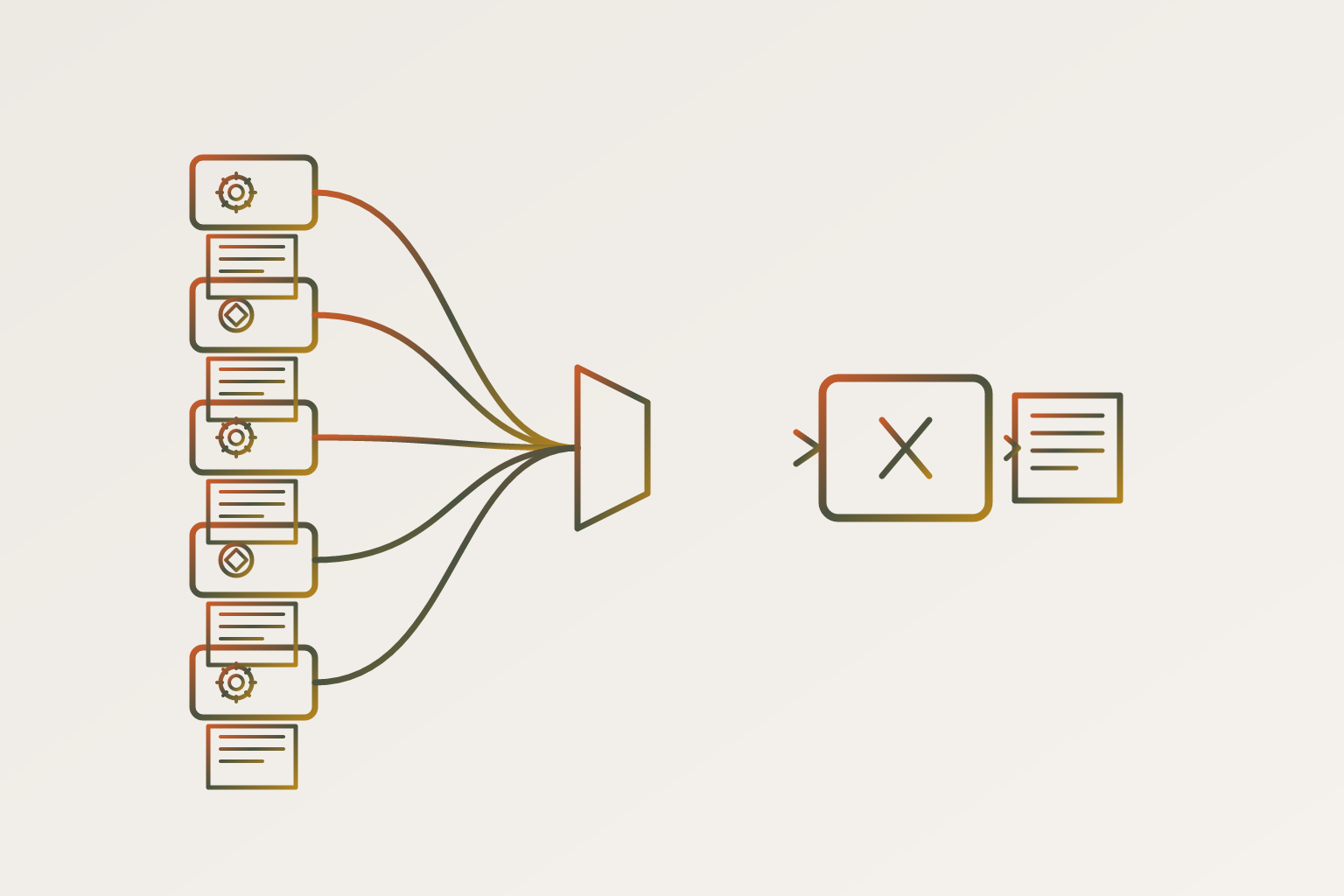
A mechanical BOM that spans multiple fabrication processes, say a CNC-machined housing, a bent sheet metal bracket, a carbon fiber panel, a cast base, and a custom spring, is normal, not an edge case. Most non-trivial assemblies hit at least three processes, and as products fold in structure, thermal management, fluid paths, and finish work all at once, that mix only grows. The instinct is to send each process to whoever's best at it: the best CNC house, the best sheet metal shop, the best composite fabricator. That instinct is wrong more often than engineers admit, and it's where the coordination problem starts.
Fragmentation isn't a sourcing mistake. It's what the market is built to produce, because splitting work by process is a fair response to real differences in tooling and skill. CNC machining, sheet metal forming, casting, composite layup: each one runs on different equipment, different labor, different quality checks. No single traditional job shop does all of it well. So splitting a BOM across five vendors feels like the responsible move. It carries costs that never show up on any single PO, though. They show up later, compounded, across the whole build, and by the time they surface, the schedule's already the one paying for it. The wrong call isn't picking a bad vendor for any one process. It's assuming five good vendors add up to one good outcome.
What fragmentation actually costs across the development cycle
Start with visibility. A 2024 survey of 1,200 manufacturing professionals found 70% of manufacturers in North America and Europe describe supply chain navigation as "very" or "extremely" challenging, and a lack of operational visibility was a widely cited factor. When a BOM's data lives across five different vendor portals, five email threads, and five quote formats, that gap isn't an accident. It's what the structure produces.
From there, the failure modes stack up fast.
Coordination overhead multiplies with every vendor added. Five vendors means five RFQs, five POs, five points of contact, five separate quality conversations, and five deliveries to track. A small team ends up running a miniature supply chain just to build one assembly.
Handoff risk follows close behind. Different shops read the same drawing differently. Parts show up at different times, in different states of finish, and interface dimensions that should mate cleanly often don't. Hole patterns drift, mating surfaces need rework before final assembly even starts, and that eats time nobody budgeted for.
Lead time piles up because these processes run one after another, not side by side. A machined base, then a welded frame, then powder coat, then assembly: the critical path is the sum of every vendor's lead time plus transit between them, not the longest single step. A 3-day CNC job plus a 5-day sheet metal job plus a 2-week anodize queue, plus transit between each stop, can add up to a month or more before anyone even starts assembly.
Version control gets exposed too. Complex BOMs with frequent engineering changes already strain spreadsheet-based tracking. Send a revised drawing to five vendors separately, and nothing guarantees it lands everywhere at once. Parts come back built to the wrong rev, and nobody catches it until final assembly.
And when something fails, fragmented sourcing produces finger-pointing instead of answers. Each vendor certifies their own piece. Nobody owns the interface, and nobody owns the finished result.
How DFM rules differ by process, and why that gap punishes fragmented sourcing
Between 70% and 80% of a product's lifecycle cost gets locked in during the design phase, before a single PO goes out. Design for manufacturing decisions made, or skipped, at that stage set the cost floor for everything that follows. That's the number that should anchor any sourcing conversation, because the leverage sits almost entirely upfront, and once it's gone, it's gone.
DFM rules aren't universal, though. What makes a part cheap and reliable in one process can be irrelevant, or actively wrong, in another.
CNC machining rewards fewer setups and avoiding enclosed cavities or sharp internal corners. Tolerances tighter than about ±0.05 mm require secondary operations, and any feature machinable from a single orientation costs far less than one that needs repositioning on the mill.
Sheet metal runs on a different rulebook entirely. ISO 2768 sets standard tolerances around ±0.5 mm for dimensions and ±1° for bends. Bend radii, flange lengths, and hole-to-edge spacing follow their own logic, nothing like machined geometry, and accurate 3D model files are essential for getting a reliable quote.
Carbon fiber is stranger still. Because the material is anisotropic, DFM means specifying fiber orientation and layup schedule, not just shape. Cutting and machining strategies must account for the material's fiber orientation in ways that have no parallel in metal work. The material's properties can be a real strength in the right application, but the machining strategy has nothing in common with metal.
Casting and injection molding bring in draft angles, wall uniformity, parting line placement, and gate location, constraints that don't exist at all in subtractive processes. These start to matter as volumes scale up toward production quantities.
Here's the gap fragmentation creates: a CNC shop reviewing a machined housing has no way to see how that housing mates with the bent sheet metal bracket sitting three lines down on the same BOM. Checking cross-process fit isn't anyone's job when each vendor only sees their own piece. A single partner reviewing the whole BOM can catch that conflict, say a tolerance that's fine for machining but forces an impossible mating condition on the sheet metal part, before any metal gets cut. That's the 70-to-80% window actually getting used instead of wasted.
The three sourcing models engineers actually choose from, and what each one trades away
Three sourcing setups cover most of what's available for multi-process mechanical work, and each one makes sense for somebody. But once a BOM crosses process boundaries, one of them starts working against the engineer instead of for them: the marketplace model. It deserves naming plainly, because it's the one that sounds best in a sales pitch and costs the most once the parts actually have to fit together.
On-demand marketplaces route jobs across a network of third-party shops, often using algorithmic matching to spread work broadly. Process coverage looks wide on paper. In practice, buyers frequently don't know which supplier is building which part, where that supplier sits, or how responsive it'll be. Quality and communication vary shop to shop, so the buyer ends up doing active vendor management anyway, on top of paying for the platform's convenience. Marketplace models typically carry a broker markup to sustain platform margins, and because the network's suppliers don't talk to each other, coordinating across processes still falls back on the buyer. That's the model that promises the most and delivers the least once a BOM gets complicated.
Specialist direct manufacturers own their own equipment and hold tight control over quality, usually within one process or a narrow set of related ones. They're excellent for fast prototyping of parts within their specialty. But a BOM spanning CNC, sheet metal, and carbon fiber still needs three separate specialist shops, three POs, three lead-time clocks running independently. The fragmentation problem doesn't disappear. It just gets spread across named vendors instead of an anonymous network.
Vertically integrated partners combine in-house fabrication, finishing, and assembly with engineering support, all under a single purchase order. One organization owns every stage, from raw material to finished, assembled part. DFM review can cover the entire BOM at once, and fewer handoffs mean fewer places for interface errors to creep in. The tradeoff: shops that are genuinely capable and fully integrated are rarer than single-process specialists, so finding one takes more digging upfront. That digging is worth it. For any BOM crossing more than two processes, this is the only one of the three that actually solves the problem instead of just renaming it.
Reshoring is pushing more OEMs toward that third model. Reshoring Initiative data puts combined reshoring and foreign direct investment announcements at 244,000 jobs in 2024, and companies pulling back from Asia-Pacific sourcing are consolidating toward fewer, more capable domestic fabrication partners rather than spreading work across sprawling networks. OneWeekParts, for instance, operates as a single-source custom parts and assembly supplier covering CNC, sheet metal, carbon fiber, casting, and more under one order. Separate industry analysis from Fabcon describes vertically integrated mid-tier fabricators as occupying the space between transactional job shops and large contract manufacturers, running laser cutting, CNC machining, finishing, wiring, and assembly under one coordinated operation, which cuts out the vendor handoffs that slow down traditional sourcing.
Where lead time actually comes from in a mixed-process BOM
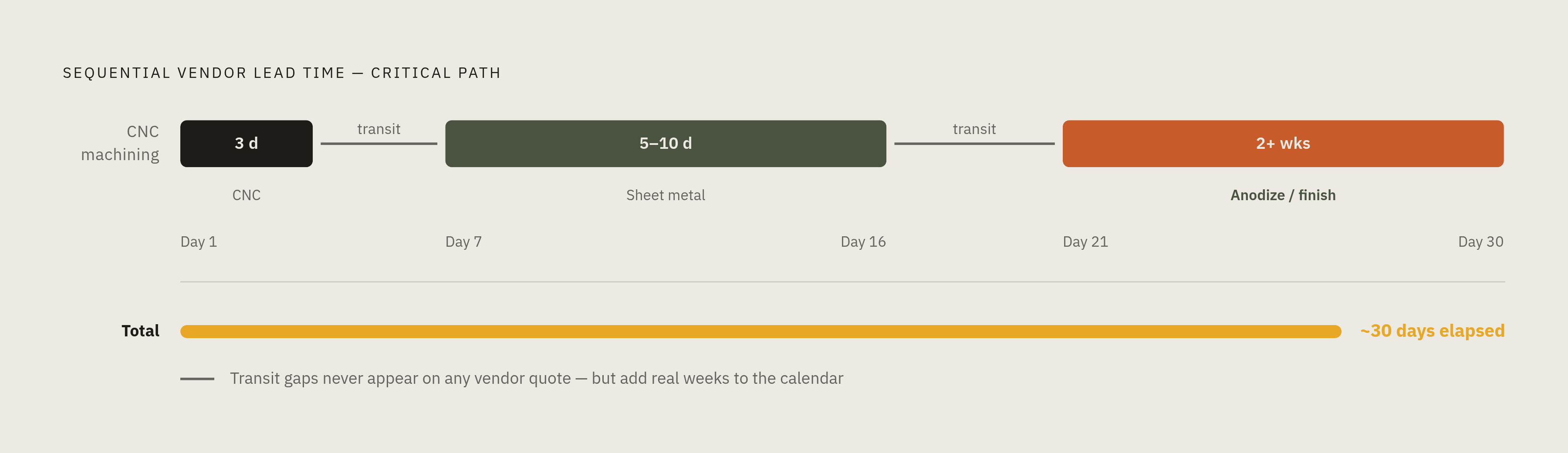
Lead time math in a fragmented BOM adds up piece by piece. When one process depends on the output of another, every vendor's queue lands on the critical path instead of running alongside it.
CNC machining alone typically runs about 3 days for prototypes, 1 to 2 weeks for low-volume orders, and 4 to 6 weeks for production runs, with rush service available at a meaningful premium over standard pricing. Sheet metal prototypes and small batches typically take a few business days to a few weeks, with complex formed geometries or stamped parts needing custom dies pushing toward the longer end. Tube bending can run longer still, with lead times varying considerably depending on complexity and how loaded the shop's schedule already is.
Stack three of those processes in sequence and the math turns ugly fast. Add the usual delay drivers, incomplete drawings, material availability gaps, tolerances that trigger extra inspection steps, secondary operations like anodizing queued separately, and the schedule slips further before anyone's even assembling anything.
Transit time between vendors rarely shows up on a quote, but it's real on a calendar. A part that finishes one process on a Friday may not arrive at the next shop until well into the following week. Across multiple handoffs, those gaps add up to real weeks, not days.
The broader supply environment isn't helping either. Lead times for some critical components reached 26 weeks in 2025, pushing manufacturers into juggling multiple sourcing strategies and swapping suppliers constantly. The same volatility hitting component supply chains hits specialty fabrication capacity too.
A partner running machining, sheet metal, and finishing inside one facility cuts out inter-vendor transit entirely, and can schedule independent processes side by side wherever the dependencies allow it. Total elapsed time from file submission to finished assembly shrinks hard against a model where each process waits in its own separate queue at its own separate shop.
What consolidation requires from the partner, and how to evaluate whether a shop actually qualifies
Consolidation only delivers what it promises if the partner actually covers the process mix in-house. A shop that markets itself as vertically integrated but quietly subcontracts carbon fiber layup or tube bending to an outside vendor hasn't removed the handoff. It's just moved it one layer back, out of sight, where the engineer can't see it happening. Watch for that above everything else on this list, because it looks identical to real consolidation right up until a schedule slips and nobody can explain why.
Start with process coverage. Ask directly whether every process on the BOM happens in-house, or whether anything gets brokered out, and push past CNC and sheet metal into the specialty stuff: wire EDM, urethane casting, custom springs, gaskets, tube bending. That's usually where a shop's real limits show up.
Check when DFM feedback actually arrives. If it's built into the quoting process, that's the window where it can still change cost. If it's a separate paid engagement that happens after the PO is signed, the leverage is already gone.
File format flexibility matters more than it sounds. A partner handling a full BOM will get CAD files, drawings, spreadsheets, and reference images in a mix of formats. A shop worth consolidating around should work with STEP, DXF, PDF drawings, and native CAD files directly, without making the engineer reformat everything first.
Quality ownership is worth pressing on specifically. Does one quality system cover fabrication, finishing, and assembly together, or does each process run its own inspection with no traceability connecting them? Fabcon's analysis notes that integrated quality management produces traceability records spanning every stage of a build, from raw material through finished assembly. That continuity matters for regulated programs, and it matters just as much when a field failure needs a root cause fast.
Confirm the administrative side actually consolidates too. One PO should cover the full BOM. One shipment should cover the full assembly. If the partner still splits things into multiple POs or ships processes separately, the paperwork burden consolidation is supposed to remove hasn't actually gone anywhere.
Responsiveness deserves a real check. Same-day access to an engineer during quoting and review compresses the back-and-forth that otherwise drags on for days over email. Ask directly how fast the shop turns around DFM questions and drawing clarifications, and treat the answer as a real data point, not a formality.
Last, ask about remake or refund policy. A shop confident in its own quality system backs that confidence with a guarantee. No guarantee at all says something about where accountability actually sits.
The file and BOM preparation work that makes consolidation succeed
Consolidating vendors takes weight off procurement, but it shifts real work onto file and BOM prep. A partner quoting a 20-part mixed-process BOM can only move fast if the input is complete and unambiguous from the start.
For CNC parts, that means full CAD with GD&T called out wherever it actually matters, and tolerances specified only where the function demands them. Over-tolerancing a non-critical surface adds machining cost for zero benefit. Wherever possible, design features so they machine in a single setup instead of requiring repositioning.
For sheet metal, Accurate 3D model files are essential for engineering review and quoting. Bend allowances, material grade and thickness, and finish requirements need to be called out clearly on the drawing itself, not left implied.
Across the BOM as a whole, listing process type, material, quantity, and finish for every single line item lets a partner quote the entire scope in one pass instead of sending items back for clarification one at a time. Reference images help too, especially on complex assemblies where the drawing alone leaves room for interpretation.
Engineering change control is where a consolidated partner earns its keep. When one shop holds the whole BOM, a revision to a single part gets communicated once and applied everywhere it matters, at the same time. That's the version control advantage fragmented sourcing structurally can't match: no five-vendor email chain, no risk of one shop building to a stale rev while the others catch up.
Watch for the errors that repeatedly stretch out quoting and manufacturing time: incomplete tolerance callouts, file and drawing revisions that don't match each other, finish requirements left unspecified on mating surfaces, and missing material certifications on anything headed for a regulated application. None of these are exotic mistakes. They're the ordinary ones that show up on almost every BOM that hasn't been checked carefully before submission.
The prep work is front-loaded, no question. But a clean file package and a well-structured BOM, built once, become the baseline for every repeat order after that: no re-quoting from scratch, no re-explaining the assembly to a new vendor. That's the payoff on the upfront effort, and it's the same logic that makes consolidation worth the switch in the first place.